Labrador, golden retriever, and German shepherd are the most commonly used breeds as guide dogs due to their physical attributes and temperament.
The different stages that a guide dog goes through before becoming the eyes of a blind person are breeding, socialization, training, and daily life.
At the facilities of the ONCE Guide Dog Foundation (FOPG) in Boadilla del Monte (Madrid), they work with these animals to ensure their well-being and provide safety and autonomy to blind people in Spain.
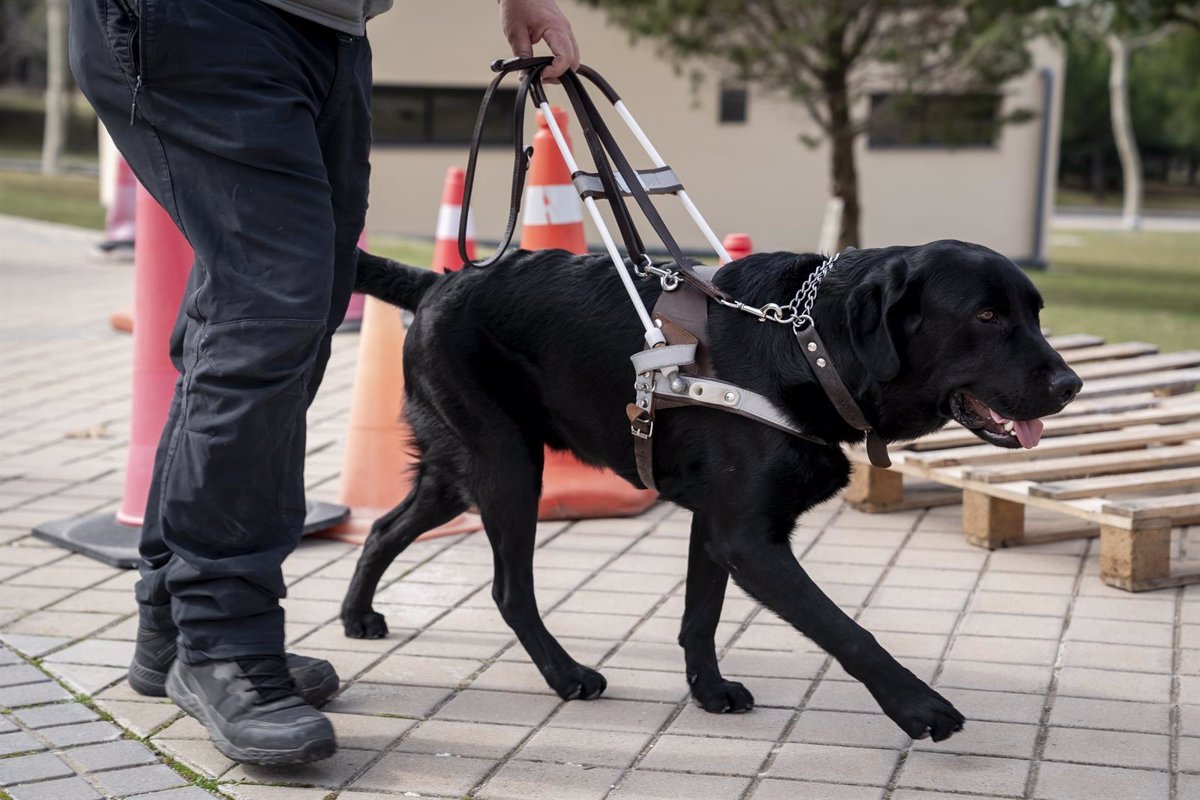
Mobility instructors at the center train the dogs to navigate obstacles, climb and descend stairs, find a door or a pedestrian crossing. ‘Osiris’, a black labrador nearing the end of his training, already excels in these tasks.
The school, equipped with a laboratory, veterinary clinic with an operating room, training area, and whelping block, is currently expanding with the goal of delivering 200 dogs each year.
Currently, around 1,000 ONCE guide dogs walk alongside society in cities and towns across Spain, enhancing autonomy, mobility, and safety, making these animals an integral part of Spanish citizens’ lives.
In its nearly 35-year history, the ONCE Guide Dog Foundation has provided over 3,000 guide dogs to around 1,900 different users.
More than 35% of them have renewed their guide dog through the foundation after retirement or the passing of their previous mobility assistant. The most commonly used breeds are labrador retriever, golden retriever, and German shepherd due to their physical attributes and temperament.
«The best dogs are trained here to improve the quality of life for blind people because these dogs change their lives,» explains Imelda Fernández, Vice President of Grupo Social ONCE.
The organization’s Vice President ensures that they prioritize the well-being of the animals from birth throughout their lives: «They guide and do so happily.»
On the other hand, María Jesús Varela, Managing Director of the ONCE Guide Dog Foundation, emphasizes that the center’s goal is to «provide independence to blind people.» «And also ensure that the dog, which will perform this magnificent work, does so while receiving all the necessary care, attention, and that it is a satisfying activity for them,» she adds.
«As everyone who loves animals knows, a dog wants nothing more than to do something that pleases its owner. In this case, these dogs are selected from the beginning, even before birth, to be dogs that enjoy being with people, are sociable, and we teach them how to behave from start to finish,» she emphasizes.
Guide dogs, as Varela points out, start their lives at this center, and many also end their lives there because, even though the vast majority of blind people keep them after retirement from guide dog duties because «it’s impossible to separate from them,» when they can’t keep them, the foundation takes them back.
WORK BEGINS EVEN BEFORE CONCEPTION
The center ensures the care of the dogs from birth, even when their mothers are still pregnant, until they are delivered and paired with a blind person.
The foundation works before the animal’s conception with a rigorous selection of its parents to obtain intelligent, healthy puppies with a sociable and balanced character. The breeding dogs live outside the center, cared for by foster families.
Once born, the puppies grow up in the school with their mothers, cared for by their handlers and monitored by the veterinarian.
At two months old, the puppies are taken in by educator families selected by the foundation, which provides the necessary technical support and covers all the costs of fostering.
These educator families that adopt them during this period play an essential role, that of socialization. In addition to developing, playing, and receiving lots of love, the dog learns to live with close and unfamiliar people and to get used to situations, objects, and sounds like public transportation, stores, or noise. It is an ideal stage to acquire a basic level of obedience.
At fourteen months, the dog returns to the school and begins its training. When it completes its instruction, the dog is capable of making decisions in complex situations: signaling crossings and stairs or finding pedestrian crossings.
Once prepared to guide, it is time to assign the dog to the blind or visually impaired person it will guide. The instructor selects them considering their needs, abilities, environment, as well as the dog’s characteristics.
In a course taught by the instructor, the dog and its future user learn to work together and build mutual trust. From this moment on, the user’s movements will be more autonomous and secure.
NEW ROYAL DECREE TO REGULATE THE ACTIVITY OF GUIDE DOGS
The Government will likely approve a royal decree this year to regulate the activity and well-being of dogs that assist people with disabilities and allow them to access public spaces throughout the national territory.
This new Royal Decree will complement the legislation of each autonomous community regarding these animals and at the national level, it will replace the current regulations that refer to another Royal Decree from 1983.
The Animal Welfare Law already included that pets could enter public spaces, but it allows establishments to expressly prohibit their entry. With the new royal decree, guide dogs for people with disabilities can accompany their owners even if there is an explicit prohibition on animal entry.
.
FUENTE