Women criticize that the starting prices are lower than those of men and demand equality: «We have been relegated»
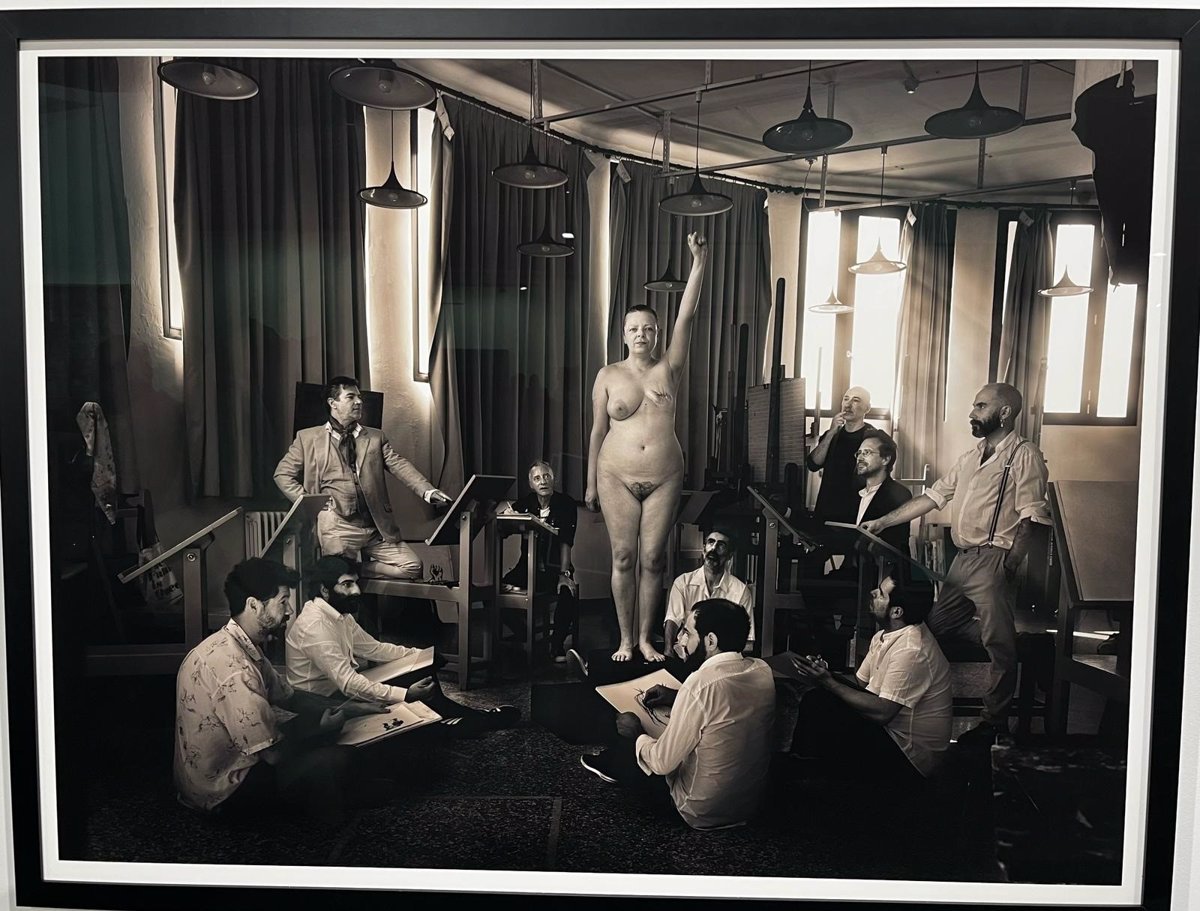
The 44th edition of ARCOmadrid is composed of 40 percent women, a figure «improvable» as stated by its director Maribel López, in statements to Europa Press, and which is also insufficient for some of the artists exhibiting their works, such as Marina Vargas, creator of the work ‘Breaking the Canon’ in which she replicates Eugène Delacroix’s painting ‘Liberty Leading the People’.
«The visibility field that women have is more limited and in the market we have a value that is often more precarious in an unfair way,» she asserts in statements to Europa Press, lamenting that the art market is «patriarchal.»
The artist laments that women are «far behind» men in the sector, although she believes that the situation is changing and efforts are being made in that direction. «We must continue working and raising awareness in the entire cultural panorama gradually,» she asserts.
Vargas makes her own «sick» body visible in ‘Breaking the Canon’ with her left arm raised, having lost her left breast due to breast cancer. «Normally you can’t raise your arm because they remove the lymph nodes, but I had to do it because it was a gesture of resistance and feminism,» explains the artist, who describes her piece as a «deconstructive, ironic, and essentially feminist» work.
One of the works that has generated the most buzz in the first two days of ARCO is ‘Dat-Astral Chart’ by Noemí Iglesias, exhibited at the Moises Pérez de Albéniz Gallery, where the King and Queen stopped by this past Wednesday. «They found it very interesting, although the Queen was a little scared,» jokes the artist in statements to Europa Press.
Noemí Iglesias points out that «there are only 5.8 percent of female artists in Spanish galleries,» a figure that, as she herself indicates, «is considerably lower than in other editions.» «There is still much work to be done for there to be equality in terms of female representation,» she warns.
«There are some institutions that support female artists and thus advocate for equality with men. But there are other entities that are more indifferent when it comes to offering scholarships,» she points out.
On the other hand, Inma Herrero, creator of ‘Glacier I,’ the cheapest work at ARCO, emphasizes the importance of the fair’s commitment to female presence, although she adds that she has «never» felt discriminated against because of her gender. «We have very important things to say and they have to give us the space to do so. It is important that there is a male perspective, but also a female perspective,» she has stated.
LOWER STARTING PRICES
Another artist present at ARCOmadrid 2025 is Concha Jerez, who, with her work ‘Censored Obituaries of Forgotten Women’ exhibited at Freijo Gallery, vindicates those women who are only known through their obituaries. «Many wonderful women, with a very full life, I have known through the newspaper. I found it interesting to bring this work here and vindicate them,» she has said.
Furthermore, she points out that the role of women in these types of events should continue to be vindicated because «many have paved the way.» «I think my recognition at ARCO is changing because they are accepting younger women, something that was more difficult before,» she admits.
However, she laments that starting prices are still lower for women than for men. «It not only happens in Spain but internationally. It is flagrant and should not happen,» she emphasizes.
This criticism has also been shared by Tania Blanco, author of ‘Self-portrait of a Palestinian journalist working in Gaza and Hallamar,’ two pieces exhibited together at the FormatoComodo gallery.
«I think the colleagues who say it are right. Once a collector came to my studio and had me showing him things all morning. A few days later, someone who knew him told me that he would never buy a work from a woman because he said there were hardly any women in Art History,» she recalled.
Blanco, who in her work shows the differences in life in Palestine at the beginning of the century and today, acknowledges that there are «backward» people in the art world who make such «completely outdated» assessments. «Of course, there are fewer women in Art History and in books, but because they have been relegated to a secondary role,» she criticized.
«Relations of power must be progressively balanced, and there must be greater equality,» she concludes.
«THE DIFFICULTY NOW IS DOING SOMETHING WITHOUT TAKING WOMEN INTO ACCOUNT»
Finally, the president of the Consortium of Contemporary Art Galleries, Idoia Fernández, believes that percentages should not only be between men and women and asks for consideration of which galleries are working in historical moments or geographical areas where there was not as much female presence.
«Perhaps many focus on historical avant-gardes, that is, on artists who have already disappeared or from the early 20th century or mid-20th century, so perhaps obviously there were fewer women who dedicated themselves professionally or almost professionally,» she explained.
Regarding the absence of women in Art History, she recalls that many past artists dedicated themselves to creating but «were not paid much attention and many returned to their homes.» «It was a very difficult world for a woman to do almost anything,» she emphasizes.
Nevertheless, she insists that things are changing and highlights that currently «there are very good young artists» who deserve spaces to showcase their work. «Now, the difficulty is doing anything in contemporary art without considering women because there are many and very good ones,» she concludes.