
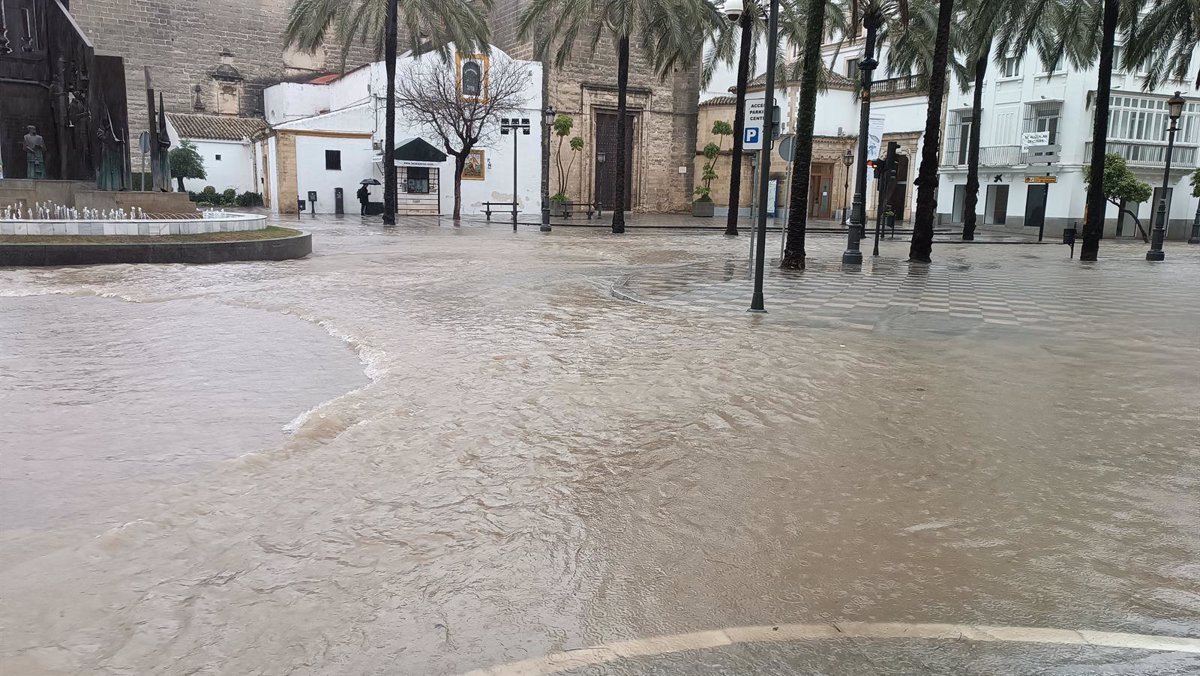
The passage of the storm Jana has already left 1,322 incidents managed since March 5 at the Emergency Coordination Center 112, belonging to the Emergency Agency of Andalusia. During this Wednesday, about fifty incidents related to rain and wind have been coordinated from the emergency phone line, as reported by the service attached to the Ministry of the Presidency, Interior, Social Dialogue, and Administrative Simplification of the Junta.
The majority of the incidents managed until this Wednesday afternoon have occurred in the province of Cadiz, where an orange warning has been activated for accumulated rainfall of up to 35 liters per square meter in an hour until 9:00 p.m. These incidents have been related to waterlogging on roads and streets, partial flooding of homes, rockfalls on roads, and problems in the road network. Most of the incidents have taken place in Jerez de la Frontera and Chipiona, although other municipalities such as Arcos de la Frontera, Sanlúcar de Barrameda, Jimena de la Frontera, or Rota have also been affected.
In Jerez de la Frontera, several people have had to be rescued from their vehicles by the Civil Guard after getting trapped on the road that connects the Jerez circuit with Estrella del Marqués due to the overflow of the Arroyo del Gato. Also in Jerez, the Local Police rescued a woman from her home on Colonia de Caulina Street because water was entering the building. So far, there have been no reports of injuries.
In the province of Cadiz, the storm has caused the closure of road CA-3105 at kilometer 1 (Jerez de la Frontera) and CA-5101 (Arcos de la Frontera), both due to waterlogging. Also, on road CA-8201, between kilometers 2 and 29 (Jimena de la Frontera), traffic has been cut off due to landslides on the road.
In the other Andalusian provinces, the day has been «quieter» in terms of the number of incidents managed, although the Emergency Agency continues to monitor the rivers, reservoirs, and river flows in case preventive measures need to be taken for the population.
In total, since the beginning of this storm on Wednesday, March 5, 1,322 alerts have been managed throughout Andalusia. By provinces, Malaga and Cadiz have recorded the highest number of incidents, with 338 and 298 respectively. They are followed by Seville (200), Huelva (168), Granada (119), Cordoba (114), Jaen (48), and Almeria (37). The day with the most alerts was on Saturday, March 8, when up to 491 incidents were attended to in Andalusia.
The Phase I of the Plan for Flood Risk Emergency in Andalusia (PERI) remains active. This emergency phase refers to a phenomenon that involves damage – or when deemed appropriate by the Plan’s Director – and for which the necessary measures are implemented for the rescue and protection of people or property.
The operational situation 1 covers emergencies that can be managed using the available resources in Andalusia, or with occasional support from resources that do not require specific coordination by the central bodies of the National Civil Protection System.
The State Meteorological Agency has extended the yellow alerts for rain and storms in Cadiz and Huelva until midnight. This Thursday, all Andalusian provinces, except Jaen, will have some yellow alert for rain, wind, storms, or coastal phenomena throughout the day.
In the face of these adverse weather events, it is recommended to exercise caution and adopt self-protection measures to avoid risks and ensure safety. During heavy rainfall, it is advisable to avoid travel if possible, but if necessary, inform yourself about the road conditions before setting off and follow the instructions of information panels and authorities while on the road, as well as stay informed through radio broadcasts from authorities and relevant services.
When driving in rain, extreme caution is advised, reduce speed, and increase the following distance. Never drive through flooded areas. If you have crossed a flooded area for any reason, test the brakes lightly to ensure they are working. If caught in a sudden flood inside the vehicle, be prepared to exit immediately when the water surpasses the wheel axis.
Avoid parking or traveling near riverbeds, even if they are dry, to prevent being caught by a sudden flood. Also, avoid basements and ground floors. In the countryside during a storm, isolated trees and rocks attract lightning, so they should be avoided, as well as metallic objects. In coastal areas during a storm, avoid walking on promenades, breakwaters, and viewpoints as the waves can suddenly pull you into the sea.
In the event of strong winds, it is recommended to close and secure doors and windows and remove any furniture and objects (such as awnings, pots, clotheslines, and flowerpots) from the outside of the houses that could fall onto the street and cause an accident.
If you are on the street or in the countryside and facing strong winds, do not seek shelter near walls or fences; it is advisable to move away from ledges or trees that may fall. Additionally, take extra precautions if you are near buildings under construction or in poor condition. Whenever possible, on windy days, it is best not to climb scaffolding or similar platforms that may be displaced.
If caught in a car during strong winds, do not stay inside the vehicle but seek a safe place to take shelter. It is important to stay calm and follow information from official sources on social networks and media to avoid rumors and false information, and in case of emergency, call 112, available 24 hours a day, every day of the year.
FUENTE