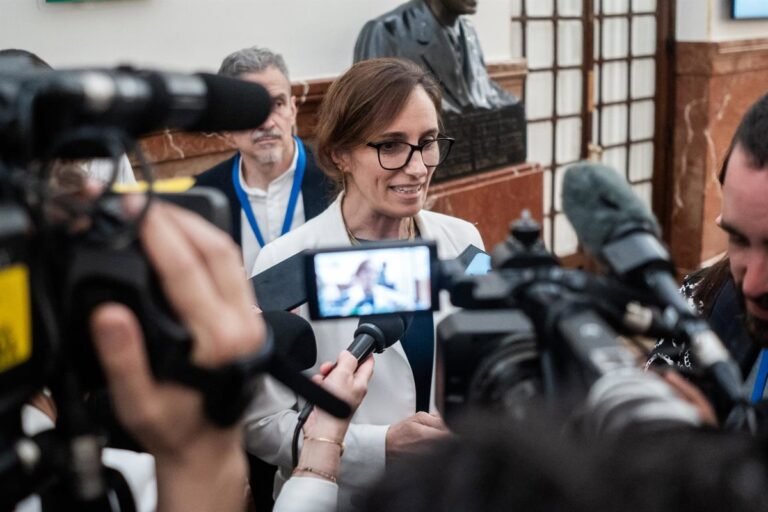

The ministers Víctor Torres and Pilar Alegría preside over the delivery of the mortal remains of four exhumed individuals from Cuelgamuros.
MAGALLÓN (ZARAGOZA), 12 (EUROPA PRESS)
The Minister of Democratic Memory and Territorial Policy, Ángel Víctor Torres, and the Minister of Education and Government Spokesperson of Spain, Pilar Alegría, chaired this Wednesday, March 12, 2025, in Borja and Magallón, the tribute to the 17 people assassinated in August 1936. During the event where the remains of the four identified deceased were delivered, Torres urged to «celebrate democracy and not allow anyone to take it away from us.»
Minister Víctor Torres mentioned that 15 people have already been identified in the Valley of Cuelgamuros. «I was fortunate to call the mayor of Magallón, Esteban Lagota, in June, and inform him that among the people we had identified was his grandfather, who had the same name as him, who was a victim of the war, violently shot and his body hidden.»
«This act on Tuesday should not bother anyone,» Torres continued, asserting: «So that this never happens again.» He expressed that some people have been placing flowers in a common grave «assuming that their ancestor was there, who was shot during the civil war or in the following years, only to find out that they were actually removed in the 1940s and 1950s and taken to the Valley of the Fallen, and now they can take flowers to them wherever they want.»
«Today we enjoy democracy, freedom, rights, the ability to express our opinions without fear, to vote for whoever we consider, thanks to those who even lost their lives» in those years, the minister continued, urging to «make it reach the youth, those who have been fortunate to be born in democracy, those we hope will not have to go through what our grandparents went through, who could not speak, had to hide their feelings, suffered repression by totalitarianism, by an illegitimate and illegal coup, and no one should advocate for its return.»
«This does not reopen any wounds, but closes a circle; everyone has the right to know where the remains of the people they loved are buried,» he concluded, after which he recalled that the identification work of more bodies in Cuelgamuros continues, in a «race against time» because «time is not on our side as the years go by, there are fewer relatives left, and it gets more complicated.»
The Minister of Democratic Memory commented that there have been individual demands. On the other hand, Torres considered that «it is an absolute mistake to repeal regional democratic memory laws and not defend human rights, protect victims, dignify memorial associations,» referring to the repeal of the Aragonese law in the first year of this legislature.
«The ignorance of history has a great risk and its repetition,» emphasized Víctor Torres, lamenting that the regional government of Jorge Azcón maintained the repeal of the regional law after the exit of VOX from the government.
JUSTICE AND REPARATION
Minister Pilar Alegría emphasized that this is «an act of memory, justice, and reparation, of democracy,» stressing that 66 years have passed for these four individuals – the identified ones – to «receive that dignified burial in this pantheon, in Magallón, and for this act of reparation to be carried out, in collaboration with memorialist associations and with historians and forensic experts.»
«We will continue working on these humanitarian tasks so that more and more relatives, who have spent so many years without knowing where the remains of their loved ones were, can finally give them a dignified burial in their own municipalities, like these four neighbors of Magallón and Añón de Moncayo today.»
The mayor of Magallón, grandson of one of the victims, Esteban Lagota, told the media that the identification of the remains of his relative in Cuelgamuros has brought «joy and, at the same time, a bit of nostalgia.»
«Finding the remains is a satisfaction, closing a circle, a small reparation, a chapter that closes,» Lagota continued, adding that «by chance» his father found out that «they took» the remains of his father to the Valley of the Fallen «because the gravedigger in Borja was from Magallón and told him.»
The delivery of the remains of his grandfather and four other individuals was «an act of true democratic purity, of tranquility,» he insisted: «They were taken from the cemetery without informing the family, if anyone knew, it was by accident, and they were taken by order of Francisco Franco to the then Valley of the Fallen, and after a process carried out by the State Secretariat of Democratic Memory, we have been able to identify four of these individuals.»
During the event, several relatives collected the mortal remains of Esteban Giménez Ezpeleta; Juan Chueca Sagarra; Felipe Gil Gascón; and Pedro Peralta Gil, indicating their place and date of birth. They were arrested in the early weeks of 1936 for their political activism and died days later, being buried on August 21 of that year.
Forensic expert Paco Echeverría stated that many years have passed and that his team consists of 20 experts, who have prepared a technical report for each of the identified individuals, urging to distinguish between «the very difficult and the impossible.» He showed a pencil that one of the victims carried, mentioning that some had personal belongings.
Echeverría urged to continue working to «consolidate democratic values and the discourse of human rights» with the exhumations at the Valley of the Fallen.
PLAQUES IN BORJA
Before the solemn event at the ‘Ramón Salvador’ Auditorium in Magallón, the ministers visited the cemetery of the nearby town of Borja, accompanied by the Government Delegate in Aragon, Fernando Beltrán, the mayors of both municipalities, and a representative from the Polish Embassy in Spain.
In the cemetery of Borja, they saw two plaques, one in memory of the 20 residents of Borja «murdered victims of the fascist dictatorship» and another with the names of the 17 who were buried in the Valley of the Fallen, of whom the remains of four were delivered this Wednesday, previously identified by the forensic team of Francisco Echeverría.
«On April 8, 1959, the remains of 17 people who were murdered in 1936 were taken from the common grave of this civil cemetery (Borja),» they state on one of the plaques, placed by the Association of Relatives and Friends of the Murdered and Buried in Magallón. The unidentified remains rest in the association’s pantheon in Magallón.
These individuals, residents of Borja, Magallón, Bulbuente, Trasobares, Añón de Moncayo, and Fuendejalón, were Juan Chueca Sagarra; Felipe Gil Gascón; Esteban Giménez Ezpeleta; Conrado Gil Ruberte; Estanislao Bosque Gil; Zacarías Viñes Bercebal; Bonifacio Ezpeleta Gascón; Ismael Lahuerta Sanmartín; Demetrio Francés Roy; Higinio Garcés Ramos; Pedro Mediel Gil; Escolástico Gomara Redrado; José Magallón Garcés; Pedro Peralta Gil; Pedro Santa Eugenia Garcés; and Benito Barcos Laborda.
FUENTE