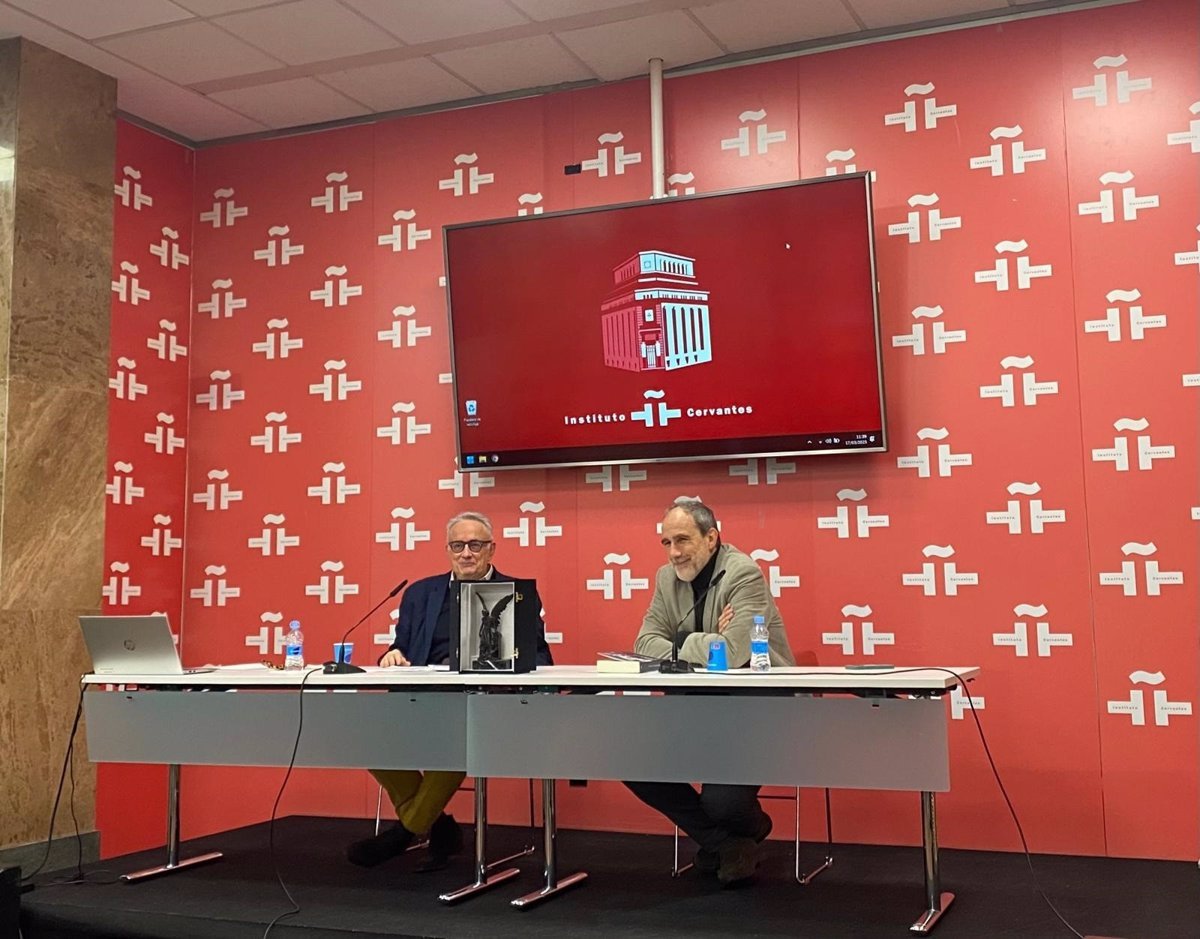
The Instituto Cervantes will pay tribute this Monday to the writer Carmen Martín Gaite and will keep in the Letter Box material belonging to the author such as unpublished letters and out-of-print books, coinciding with the centenary of her birth and the publication of her biography ‘Carmen Martín Gaite’ (Editorial Tusquets), written by José Teruel and recently awarded the 2025 Comillas Prize.
«The legacy will consist of the complete works of Carmen Martín Gaite, whose first three volumes were destroyed, that is, they are out of print (…) and in the correspondence with Juan Benet. Also, unpublished family photos will be delivered, one with her sister. Two handwritten postcards to her mother and father will also be delivered. A beret will be given, a very significant object in Carmen Martín Gaite’s public representation, a beret with its corresponding brooch,» detailed José Teruel on Monday morning at the press conference presenting the biography ‘Carmen Martín Gaite’.
Awarded the 2025 Comillas Prize, this biography by Teruel aims to «revive» for the reader the key moments and relationships that defined Gaite’s life, through the relationships she maintained with herself, a «fundamental aspect in an autobiographical discourse,» as detailed by the author, as well as with others.
«How Carmen Martín Gaite presented herself to others and how she saw herself. These were the questions that constantly circulated in my mind. Therefore, we have three main pillars, columns in this biographical account: The intimate biography, the construction of the public image, and the exegesis of her work,» indicated José Teruel about Gaite, who throughout her career received numerous awards, including the Prince of Asturias Award for Literature in 1988.
In shaping the biography, Teruel highlighted that he tried to ensure that the «experience does not dry up into information» and distance himself from other biographies that are mere elongated chronologies.
«I needed the archives, of course, and to narrate, to bring out the voice of the documents and my voice, my voice as a chronicler, honest, modest, not Olympian, rigorous, skillful, and also careful with words, plus her voice and the versions of others who lived with her,» specified Teruel, who met Carmen Martín Gaite in 1986.
At just 26 years old, Teruel spoke for the first time with the author thanks to her, after reading an article of his on memory and its hiding places in ‘El cuarto de atrás’ (1978), she called him to say she liked it. «She invited me to her apartment on doctor Esquerdo and we had tea, I remember it perfectly,» he recounted, and from then on, he coincided on several occasions with Gaite, with whom he never formed a friendship.
«I cannot affirm that I was an intimate friend of Carmen Martín Gaite, although I maintained a very cordial, but sporadic, relationship with her. From that direct interaction, I can deduce that everything about Carmen Martín Gaite’s external appearance, all her social behavior, was designed to facilitate access. She was an accessible person,» revealed Teruel, who noted about the author that after the death of her daughter Marta, «literature was the only thing she had.» «And that was noticeable right away,» according to the author.
Over 11 chapters, Teruel traces the life and personality of Carmen Martín Gaite through her family background, her formative years in Salamanca and her friendship with Ignacio Aldecoa, her marriage and separation from Rafael Sánchez Ferlosio, her relationship with her daughter Marta, the first half of the 80s, and her final years of life in solitude.
«In short, characters, environments, circumstances, that could have most significantly influenced the development of Martín Gaita as a woman and as a writer. This is the map of the book,» added Teruel.