
Spoilers for “The Interstellar Song Contest.”
No, really, spoilers from here on out.
Much like Eurovision itself, that was a lot, wasn’t it?
And much like every other episode this season, “The Interstellar Song Contest” was overstuffed, excessive, and brutally short. It was also a lot of fun, even if the sheer volume of plot that I wish we’d had more time to explore remains frustrating. Unfortunately, it looks like the great qualities of this episode will be overshadowed by all of the dramatic lore reveals. As usual, head to Mrs. Flood Corner for the analysis, but let’s talk about the rest first.
Eurovision?
If you’re in the US, you may not be familiar with the Eurovision Song Contest, even if Netflix did make a movie about it. It’s an annual music competition that began in the post-war years that saw the major nations of Europe select an act and a song to compete. Judges from each nation would then rank each performance, with the winning act’s nation going on to host the event the next year. Despite the name, participation isn’t limited to Europe, with entries from Oceania, Africa, and the Middle East. And the event, to use a technical term, is Extremely Gay, playing up its camp excesses and offering a space for queer performers.
“Did you just fly through space on a glitter cannon?”
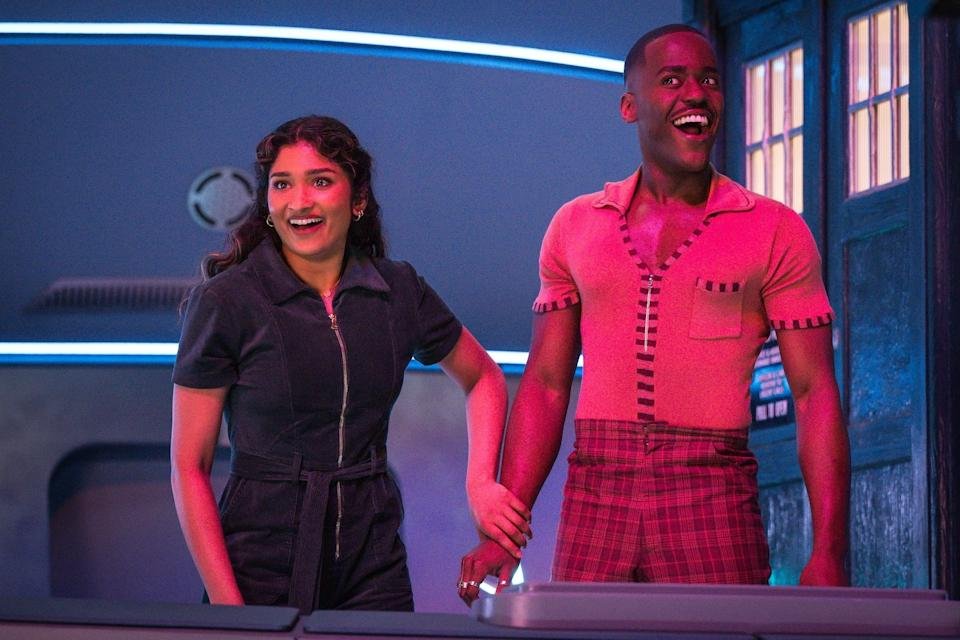
The Doctor and Belinda arrive in a VIP box in the Harmony Arena, a large open-air (given it’s in space, should that be an open-space?) venue. They’re just in time to see the start of the 803rd Interstellar Song Contest, presented by (actual British TV presenter) Rylan Clark, who has just emerged from a cryogenic chamber. The Doctor takes the Vindicator reading and has enough data to force the TARDIS back to Earth on May 24, 2025 — but the pair decide to stay and enjoy the show. Watching from afar, Mrs. Flood delights that the Vindicator is now primed and ready but will stay around to watch the show as well.
It’s a popular event, with three trillion viewers from around the universe watching the show, as it’s broadcast much like a TV show. Unfortunately, the production gallery is stormed by Kid, a terrorist who has hijacked the arena’s security drones with help from Wynn, someone from the production crew. Kid and Wynn are both Hellions, a race of beings with prominent devil horns that are reviled across the galaxy for how they look. People assume they are evil, engage in cannibalism and witchcraft, and it’s hard for them to get jobs. The show’s director even says that they were advised against hiring Wynn because she’s a Hellion.
Kid switches the broadcast to the rehearsal feed, which didn’t feature Rylan, which piques the Doctor’s interest as there’s a TV in their VIP box. He pulls out his sonic screwdriver and starts fiddling with the equipment, but as he’s doing so, Kid opens the air bubble separating the arena from the void. And instantly, almost 100,000 people in the audience are into space, including the Doctor and the TARDIS, while Belinda is saved by the canopy’s roof closing. Wynn closes the canopies to protect the life of Cora, the odds-on favorite to win and the show’s star act. The director notices that the people may be frozen, but they’re trapped within the station’s mavity bubble and could therefore be rescued.
The Doctor, knocked out and frozen, in the void of space, is awoken with a vision of Susan (!) in the TARDIS telling him to “find me.” He opens his eyes, spots a glitter cannon floating nearby, and propels himself toward the station’s airlock, Wall-E style. It’s there he meets Mike and Gary, the couple whose VIP box he inadvertently stole. They were thankfully safe in the corridor outside when the roof was opened. The Doctor, aided by his new friends, starts working out what the next part of Kid’s plan is — to push a delta wave via the broadcast to all three trillion of its viewers. The wave was powerful enough to knock the Doctor to the floor and give them a nosebleed and will likely kill every single viewer.
Kid and Wynn are doing this because their home planet, Hellia, was bought by the corporation that sponsors the song contest. It was the home of a poppy that could make honey flavoring, and when the corporation bought the planet, it took the poppy and burned the rest, including its people. The Hellions were scattered, victims of a genocide, looked down upon by the rest of so-called respectable society. Wiping out both the audience and the viewers at home at an event sponsored by the corporation will, Kid hopes, balance the books.
Belinda winds up with Cora, the show’s star act (and her partner). The trio hack the system to work out what is going on. Belinda, believing the Doctor is dead, is full of remorse at having never told him how wonderful she thinks he is. Thankfully, they’re able to access the station’s video calling software to see the Doctor and Kid meet via an intra-station call, where the Doctor is giving Kid a glimpse of how furious the Time Lord can get, much to Belinda’s surprise. Flood’s survival in space was a testament to her Time Lady abilities, as she bi-generated into The Rani, vowing to bring terror to the Doctor. The Doctor, with Belinda, rushes back to the TARDIS to confront the ominous events of May 24th, 2025. Despite their efforts, the TARDIS refuses to cooperate, signaling a looming threat. As the TARDIS doors explode, the credits roll, only to be interrupted by Mrs. Flood’s transformation into The Rani, setting the stage for a new battle against the Doctor. The episode, "The Interstellar Song Contest," delivers a mix of harrowing moments and comedic relief, tackling themes of indifference, identity, and revenge. The Doctor’s vindictive side emerges in his confrontation with Kid, showcasing a recurring theme of holding back power and fury. Flood Corner
Doctor Who has evolved from its origins before the era of home media, where episodes were broadcast and forgotten. Fans had to rely on novelizations to revisit old episodes. The show initially featured the Doctor, his granddaughter Susan, and her teachers on their adventures. However, Susan’s character was poorly treated, leading Carole Ann Ford to leave in 1964. The Doctor’s treatment of Susan, exiling her to Earth for wanting to kiss a boy, raised questions about her existence as a Time Lord. This mistreatment highlighted the show’s lack of continuity and lore.
Susan’s existence also raised questions about the Doctor’s other familial relationships. Despite hints at familial ties, the show never directly addressed them. The introduction of Susan Twist in recent episodes hinted at a regenerated version of Susan, but it turned out to be a double bluff in the end. Now, with Russell T. Davies as showrunner, the show is revisiting old concepts and characters like the Rani, who is revealed to be Mrs. Flood. This twist adds depth to the character and sets up potential for future development in the series. Ahora, tengo que disculparme por no darme cuenta la semana pasada de que el niño que Belinda vio en el callejón era Poppy (Sienna-Robyn Mavanga-Phipps) de "Space Babies". Obviamente, algunas teorías de los fanáticos han sugerido que era una señal de que las historias de "The Story and the Engine" estaban filtrándose desde la dimensión de bolsillo. Pero en la Comic Con de Cardiff a finales del año pasado, Anita Dobson (Sra. Flood) reveló que la segunda temporada estaría vinculada a "…", que fue otro episodio con una premisa de cuento de hadas similar.
Si ese es el caso, y todo lo que ha sucedido en los últimos dos años es parte de algún gran plan, entonces debe haber comenzado en "Wild Blue Yonder". Es el segundo de los tres especiales del 60 aniversario, y el episodio que vio al Doctor de David Tennant interrumpir el descubrimiento de la gravedad de Isaac Newton. Ha sido una broma recurrente desde entonces que la fuerza se conoce como "Mavity", y ese episodio también permitió que el panteón de dioses entrara en este universo. Dado que Susan Twist interpretaba a la criada de Isaac Newton, quizás la serie se trasladó al Twistverse en ese momento. O, ya sabes, la teoría de los fanáticos predominante de que esta era tiene lugar en la Tierra de la Ficción, un universo de fantasía de bolsillo representado en "The Mind Robber" de 1968.
Un hilo sutil que se ha mantenido esta temporada ha sido la insistencia casi obsesiva del Doctor en que Belinda disfrute de sus viajes. Ha hecho más de una referencia a que Belinda le está tomando el gusto a viajar con él en el TARDIS y empezando a relajarse y disfrutar de las cosas. Si la única razón por la que la conoció fue …, entonces tal vez esté construyendo involuntariamente su propio paradoja del abuelo. Lo cual sería, ya sabes, una mala cosa.
Finalmente, parece que cada episodio de esta temporada va a compartir paralelos temáticos con su equivalente del año pasado. "Dot and Bubble" y "The Story and the Engine" involucran explícitamente ideas sobre cómo la identidad racial cambiada del Doctor afecta su vida. "Rogue" y "The Interstellar Song Contest" abordan temas queer a través del prisma de un fenómeno de la cultura pop. Si es cierto, entonces "Wish World" probablemente será un episodio en el que la historia se desmenuza y la tensión aumenta hasta otro gran cliffhanger, seguido de "The Reality War", que no puede esperar vivir a la altura de la promesa de su primera mitad. Ya sabes, como el año pasado.
Advertencia de spoilers para "The Interstellar Song Contest."
No, en serio, spoilers a partir de aquí.
Al igual que Eurovisión en sí, ¡fue mucho, verdad?
Y al igual que todos los demás episodios de esta temporada, "The Interstellar Song Contest" estuvo sobrecargado, excesivo y brutalmente corto. También fue muy divertido, aunque sigue siendo frustrante la cantidad de trama que desearíamos haber tenido más tiempo para explorar. Desafortunadamente, parece que las grandes cualidades de este episodio serán opacadas por todas las revelaciones dramáticas sobre la mitología. Como de costumbre, dirígete a la Esquina de la Sra. Flood para el análisis, pero hablemos primero sobre el resto.
Eurovision?
Si estás en EE. UU., es posible que no estés familiarizado con el Festival de la Canción de Eurovisión, incluso si Netflix hizo una película al respecto. Es una competencia anual de música que comenzó en los años de posguerra, donde las principales naciones de Europa seleccionaban un acto y una canción para competir. Los jueces de cada nación luego clasificaban cada actuación, y la nación del acto ganador se encargaba de organizar el evento al año siguiente. A pesar del nombre, la participación no se limita a Europa, con participantes de Oceanía, África y Medio Oriente. Y el evento, usando un término técnico, es Extremadamente Gay, resaltando sus excesos camp y ofreciendo un espacio para artistas queer.
"¿Acabas de volar por el espacio en un cañón de purpurina?"
El Doctor y Belinda llegan a un palco VIP en el Harmony Arena, un gran recinto al aire libre (dado que está en el espacio, ¿debería ser un espacio abierto?). Llegan justo a tiempo para ver el inicio del 803º Festival de la Canción Interplanetaria, presentado por (el presentador de TV británico real) Rylan Clark, quien acaba de salir de una cámara criogénica. El Doctor toma la lectura del Vindicador, y tiene suficientes datos para forzar al TARDIS a regresar a la Tierra el 24 de mayo de 2025, pero la pareja decide quedarse y disfrutar del espectáculo. Observando desde lejos, la Sra. Flood se alegra de que el Vindicador esté ahora listo y preparado, pero también se quedará para ver el espectáculo.
Es un evento popular, con tres billones de espectadores de todo el universo viendo el espectáculo, ya que se transmite como un programa de televisión. Desafortunadamente, la galería de producción es asaltada por Kid, un terrorista que ha secuestrado los drones de seguridad del recinto con la ayuda de Wynn, alguien del equipo de producción. Kid y Wynn son Hellions, una raza de seres con prominentes cuernos de diablo que son repudiados en toda la galaxia por cómo lucen. La gente asume que son malvados, practican el canibalismo y la brujería, y les resulta difícil conseguir trabajos. Incluso el director del programa dice que le aconsejaron no contratar a Wynn porque es una Hellion.
Kid cambia la transmisión a la grabación de ensayo, que no incluía a Rylan, lo que despierta el interés del Doctor ya que hay una televisión en su palco VIP. Saca su destornillador sónico y comienza a manipular los equipos, pero mientras lo hace, Kid abre la burbuja de aire que separa el recinto del vacío. Immediately, nearly 100,000 individuals in the audience are sent into space, along with the Doctor and the TARDIS, while Belinda is saved by the closing roof of the canopy. Wynn seals the canopies to protect Cora, the favorite to win and the show’s main act. The director realizes that the people are frozen but safe within the station’s mavity bubble and can be rescued.
The Doctor, knocked out and frozen in space, is awakened by a vision of Susan in the TARDIS instructing him to "find me." He sees a glitter cannon nearby and uses it to propel himself towards the station’s airlock, reminiscent of Wall-E. He encounters Mike and Gary, the couple whose VIP box he accidentally took, and they assist him in deciphering Kid’s plan to broadcast a delta wave to all three trillion viewers, a wave powerful enough to potentially kill them all.
Kid and Wynn are seeking revenge for their home planet, Hellia, which was destroyed by the corporation sponsoring the song contest. The Doctor, along with Belinda and Cora, discovers the truth and works to stop Kid’s deadly plan.
After a tense confrontation, the Doctor manages to disable Kid’s weapon and shock him with the station’s power. The crowd is eventually rescued and Cora performs a song from Hellia, winning over the audience. The Doctor and Belinda return to the TARDIS, only to learn of Earth’s destruction on May 24th, 2025.
As they try to investigate further, the TARDIS malfunctions, signaling impending danger. The Doctor identifies the ominous noise as the "sound of May 24th," just before the TARDIS doors explode.
In a surprising twist, Mrs. Flood reveals herself as a Time Lady and transforms into The Rani, vowing to bring terror to the Doctor. The episode ends with the Doctor facing a new, formidable adversary.
Overall, "The Interstellar Song Contest" is a compelling and emotional installment of Doctor Who, blending charm with intense drama to deliver a memorable story. Less than ten years after the tragic Manchester Arena bombing, which claimed the lives of 22 individuals and left over a thousand injured, this episode of Doctor Who is both brutal and compelling. Written by Juno Dawson, who has previously contributed to the show’s wider world, this debut script pulls no punches.
Despite the harrowing moments, there are also lighthearted scenes, such as the Doctor’s flirtation with a married couple, Mike and Gary. The music and Cora’s final song add charm to the episode, with background gags sprinkled throughout.
The 45-minute format may not do justice to the depth of themes explored in this episode, including indifference to evil, cultural identity, and the value of revenge. The parallels to past episodes from the late ’80s show a continuation of thought-provoking storytelling.
The inclusion of Susan, the Doctor’s granddaughter, raises questions about the Doctor’s familial relationships that have long been ignored. Actress Susan Twist’s appearances hint at a regenerated version of Susan, adding an intriguing layer to the show’s mythology. Showrunner Russell T. Davies seems to be playing a long game with the fans, keeping them guessing until the very end. She is seen twice in the series, first appearing when the Doctor is at death’s door, urging him to “find me” (echoing Reginald Pye’s ghost wife’s message before blowing up the film canisters in “.”). The second time, she reprimands him for torturing Kid for his potential genocide.
Who is Mrs. Flood?
Susan’s appearance significantly overshadows the reveal that Mrs. Flood is actually the Rani. The Rani is a lesser-known Time Lord adversary from the classic series, appearing in only two official stories during its original run. However, the character gained popularity among fans due to Kate O’Mara’s portrayal, adding a touch of high camp excess. This portrayal somewhat softened the perception of the Rani as a Time Lord akin to Mengele, using people for her gruesome experiments. Unfortunately, the Rani appeared late in the original series and only returned once in an episode that most viewers would rather forget.
Russell T. Davies seems to be on a mission to rehabilitate concepts that didn’t work in the ‘80s for the streaming era. After reintroducing Mel as a UNIT employee last year, he is now doing the same for the Rani. Interestingly, both Mel and the Rani were created by Pip and Jane Baker, writers associated with the series’ decline before its revival under Andrew Cartmel. It is worth noting that the name Rani translates to “Queen” in Sanskrit, and Panjabi is the first South Asian actress to portray the character.
I am relieved that Mrs. Flood is revealed to be the Rani, as it puts an end to incessant discussions about the character. While not a bad character, the Rani is often viewed as the Master’s alternative in the series. I hope the finale can establish a clear distinction between the classic series’ Rani and the new interpretation beyond just breaking the fourth wall.
… and the rest
I must apologize for not recognizing that the child Belinda saw in the alleyway was Poppy from “Space Babies” in my previous review. Some fan theories suggest that this sighting indicates stories from “The Story and the Engine” leaking out of the pocket dimension. Anita Dobson hinted at Comic Con Cardiff that the second season would tie into “,” another episode with a fairytale theme.
If this is true, and everything in the past two years is part of a grand plan, it likely started at “Wild Blue Yonder,” the second 60th anniversary special where David Tennant’s Doctor interfered with Isaac Newton’s discovery of gravity. A recurring joke since then has been the force being known as “Mavity,” which also allowed gods to enter the universe. Perhaps the series transitioned into the Twistverse at that point, or it could be taking place in the Land of Fiction, as some fans theorize.
A recurring theme this season is the Doctor encouraging Belinda to enjoy their adventures. He often mentions her getting used to traveling in the TARDIS and starting to have fun. If the Doctor only met her because she was enjoying their travels, he may unknowingly be creating his own bootstrap paradox.
Each episode this season seems to have thematic parallels with last year’s episodes. “Dot and Bubble” and “The Story and the Engine” explore the Doctor’s changed racial identity, while “Rogue” and “The Interstellar Song Contest” delve into queer themes through pop culture. If this trend continues, “Wish World” will likely lead to a grand cliffhanger, followed by “The Reality War,” mirroring last year’s structure.
. The annual music competition, known as the Interstellar Song Contest, originated in the post-war years as a competition among major European nations to select an act and a song to compete. Despite the European roots, the competition now welcomes entries from around the world, including Oceania, Africa, and the Middle East. The event is known for its campy and over-the-top nature, often described as "Extremely Gay," providing a platform for queer performers to shine.
In a recent episode of Doctor Who, the Doctor and Belinda find themselves at the Harmony Arena for the 803rd Interstellar Song Contest, hosted by Rylan Clark. However, chaos ensues when a terrorist named Kid and a production crew member named Wynn, both Hellions, hijack the arena’s security drones. Kid’s plan is to use a delta wave to kill the three trillion viewers watching the broadcast, seeking revenge for the destruction of his home planet, Hellia.
As the Doctor and Belinda race to stop Kid, they uncover the true motivations behind the attack and work together to save the audience. With the help of Cora, the show’s star act and a fellow Hellion, they thwart Kid’s plan and use holographic technology to defeat him. In the end, the Doctor manages to save the day and bring Kid to justice, all while exploring themes of identity, discrimination, and redemption. A montage shows people being pulled in from the void and reactivated, first using Rylan’s cryogenic chamber, then on a larger scale in a VIP booth. Eventually, the entire crowd is returned, and Cora takes the stage to share her story and sing a song from Hellia. Initially met with hostility, she manages to win over the audience by the end of her performance. As the Doctor and Belinda head back to the TARDIS amidst applause, they are informed by a holographic Graham Norton that Earth was mysteriously destroyed on May 24th, 2025.
Determined to investigate, the Doctor and Belinda rush back to the TARDIS only to find it uncooperative despite their efforts to push it to that date. The Cloister Bell rings, the TARDIS lights turn red, and a sinister noise from outside the doors signals the approach of May 24th. Suddenly, the TARDIS doors explode, and the credits begin to roll.
However, the credits are interrupted to show Mike and Gary on Harmony Arena reviving the last person blown into space, Mrs. Flood. She reveals her survival skills and transforms into The Rani, declaring her intent to bring terror to the Doctor. As they walk away, Mrs. Flood becomes subordinate to The Rani, setting the stage for future confrontations.
The episode, "The Interstellar Song Contest," is described as a poignant and impactful installment in the series, touching on themes of love, loss, and revenge. Despite its harrowing moments, there are also lighthearted elements, including the Doctor’s flirtations and the music featured in the episode. The format of the show is criticized for not fully exploring the depth of its themes, and comparisons are drawn to classic episodes of "Doctor Who" from the late ’80s.
The narrative is praised for its complexity and character development, with recurring themes of revenge and restraint evident throughout the season. The episode’s deeper subtext and political themes are noted, particularly in relation to Eurovision and queer representation. The episode’s impact is likened to classic episodes of "Doctor Who" that tackled social and political issues in a thought-provoking manner.
As the episode concludes, the stage is set for future conflicts and revelations, with Mrs. Flood’s transformation into The Rani signaling a new chapter in the Doctor’s adventures. The episode’s blend of drama, humor, and social commentary is lauded, showcasing the enduring appeal and relevance of "Doctor Who" as a cultural phenomenon. In "The Dalek Invasion of Earth," the Doctor banishes his own granddaughter to 22nd century Earth because she wants to kiss a boy. He doesn’t give her a proper goodbye, instead locking the TARDIS doors and delivering a speech that may sound noble out of context. Susan’s mistreatment isn’t just about her abrupt departure from the show, but also how her existence fits into the show’s lore. If she is a Time Lord, a quasi-immortal shape shifter, then abandoning her in one time and place due to a crush seems like a drastic act.
Susan’s presence also raises questions about the Doctor’s other familial relationships that have never been directly addressed on screen. The show’s unspoken rule of "No hanky-panky in the TARDIS" is contradicted by the existence of a granddaughter, leading to speculations about the Doctor’s potential partners or children waiting for them on Gallifrey. Despite Susan’s limited appearances, her character is crucial in understanding the Doctor’s backstory and relationships.
The unexpected return of Susan in recent episodes hints at a long-term plan by showrunner Russell T. Davies to reintegrate classic characters into the series. The revelation that Mrs. Flood is actually the Rani, a lesser-known Time Lord foe, adds depth to the narrative and suggests a revitalization of past concepts that didn’t work in the ’80s. Davies’ approach to revisiting and reimagining classic elements of the show signals a shift towards exploring untapped storylines and characters.
As the series continues to unfold, viewers are left to speculate on the interconnected plot points and hidden agendas that have been hinted at throughout the seasons. The ongoing mysteries and surprises keep fans engaged and eager to see how the narrative will unfold in future episodes. He has mentioned several times how Belinda is starting to adapt to traveling in the TARDIS with him and is beginning to relax and enjoy the experience. If he only met her because of his time travel, then he may be unknowingly creating his own bootstrap paradox. This could potentially be a very negative outcome.
It seems that each episode of this season will have similarities to episodes from the previous season. "Dot and Bubble" and "The Story and the Engine" both explore how the Doctor’s changed racial identity impacts his life. "Rogue" and "The Interstellar Song Contest" both touch on queer themes through the context of pop culture. If this pattern continues, "Wish World" will likely have a suspenseful climax leading to a cliffhanger, followed by "The Reality War," which may struggle to live up to the excitement of its first half. This is reminiscent of the previous season. Please rephrase this sentence. Please rewrite this sentence.