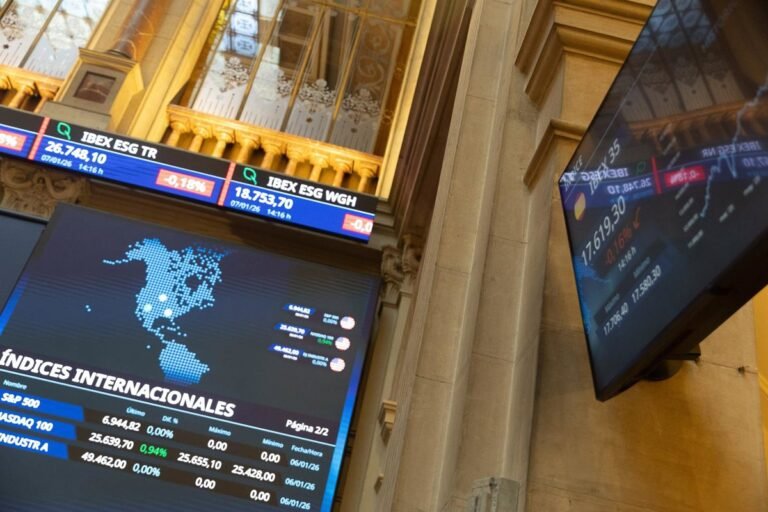

The credit rating agency S&P Global has decided to maintain Spain’s rating at ‘A/A-1’ with a stable outlook on Friday, warning that "trade tensions pose a risk to the Spanish economy," especially in light of the potential effects of the tariffs announced by U.S. President Donald Trump.
In a statement, the agency noted that Spain "is one of the fastest-growing economies in the eurozone" and the Organization for Economic Cooperation and Development (OECD). It also expects that the "robust labor supply," lower energy costs compared to other European countries, and exports will "drive growth of around 2% over the next four years, roughly double the eurozone average."
Despite this, S&P points out that Spain’s public debt "remains high" at just over 100% of GDP, also highlighting the challenges related to the approval of the General State Budgets (PGE) for 2023 and its impact on spending limitations.
Nevertheless, S&P forecasts that the high public debt-to-GDP ratio "will decrease slowly." "By 2028, we expect it to fall to 96%, returning to pre-pandemic levels from 100% in 2024. This represents a moderate 4% decrease in GDP, and the debt remains high compared to countries with credit ratings worldwide," the agency stated.
The agency also notes that pressures to increase defense spending could slow down the pace of budget consolidation. "At 1.3% of GDP, defense spending is much lower than NATO’s target of at least 2% of GDP," the agency said.
S&P highlights that unemployment "remains high by OECD standards, at 10.6%," but "has improved significantly from 23.4% in 2015." "Despite the success of the 2022 labor reform in increasing the proportion of permanent employment, labor market duality remains higher than in other advanced economies, which has fiscal consequences," it warned.
TRADE TENSIONS
In this context, S&P has warned that the risks of trade tensions to economic growth "are high globally, although Spain is less exposed to the direct effects of potential tariffs."
It pointed out that "less than 6% of Spanish goods exports are destined for the United States, and services, which make up the bulk of the Spanish economy, are not yet subject to tariffs." However, Spain "could suffer from the consequences of potential slower economic growth in the eurozone, its main trading partner," the agency cautioned.