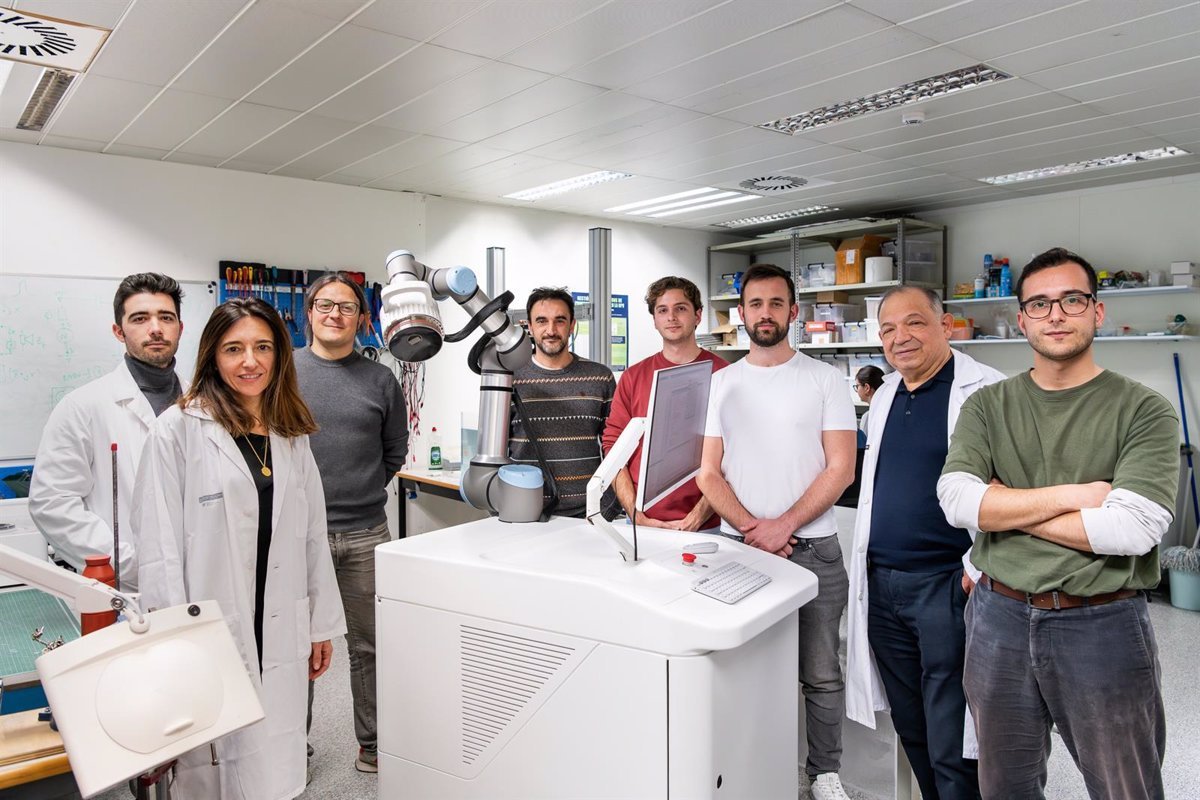
‘Lithovortex’ has been developed by the I3M, in collaboration with the NITIUV Group of the La Fe Health Research Institute (IIS La Fe) in València and the Biomechanics Institute of Valencia (IBV). According to the tests conducted so far, its application reduces the time needed to break down a stone by half, as reported by the academic institution in a statement.
This is made possible through the application of ultrasound, as it transmits waves from the outside to focus them inside the body, specifically on the stone. Furthermore, the dimensions and portability of this device could turn the treatment of kidney stones into an outpatient procedure without the need for large additional equipment, as is currently the case.
A MICROSCOPIC ‘PINCH’ ON THE STONE
As explained by Noé Jiménez, researcher at I3M (CSIC-UPV), «‘Lithovortex’ operates based on a new type of acoustic wave, which are vortex beams. We could make an analogy with a sound whirlpool, where the wave coils and rotates on itself when focused on the stone. These beams are capable of producing shear stresses in kidney stones more efficiently than a conventional beam. It’s like giving a microscopic pinch inside the stone; and that pinch causes the stone to fragment into very fine pieces, breaking down into sand that is eventually expelled through the urethra.»
The device incorporates a therapeutic head of high-intensity acoustic vortices, mounted on an automated robotic arm, and an imaging system to guide the treatment.
«The advantage of using these beams is that, being so efficient, they allow reducing the amplitude of the wave by half, thereby also decreasing the likelihood of causing injuries and pain in healthy tissues,» adds César David Vera Donoso, from the Urology Department of La Fe Hospital and head of the Integrated Urological Translational Research Core of Valencia (NITIUV) at IIS La Fe in València, who conducted the initial study.
The main application is the fragmentation of kidney stones, but just as it breaks down these stones, it could also break down other significant calcifications such as, for example, aortic valve calcification.
To date, the team at I3M (CSIC-UPV) has manufactured and validated the device with artificial stones. In collaboration with the Lithotripsy Unit of La Fe Hospital in València, the prototype has been validated ex vivo with real stones, and next year it will be validated in an animal model.
The development of this device has been made possible through a Valorization project of the Valencian Agency of Innovation. Additionally, Lithovortex was awarded at the XXXIV National Meeting of Lithiasis and Endourology, Laparoscopy, and Robotics Groups, where the work presented by Álvaro José Beviá Romero, a resident in the Urology Department of La Fe Hospital, received the Gabriel Valdivia Prize for Technological or Surgical Technique Innovation.