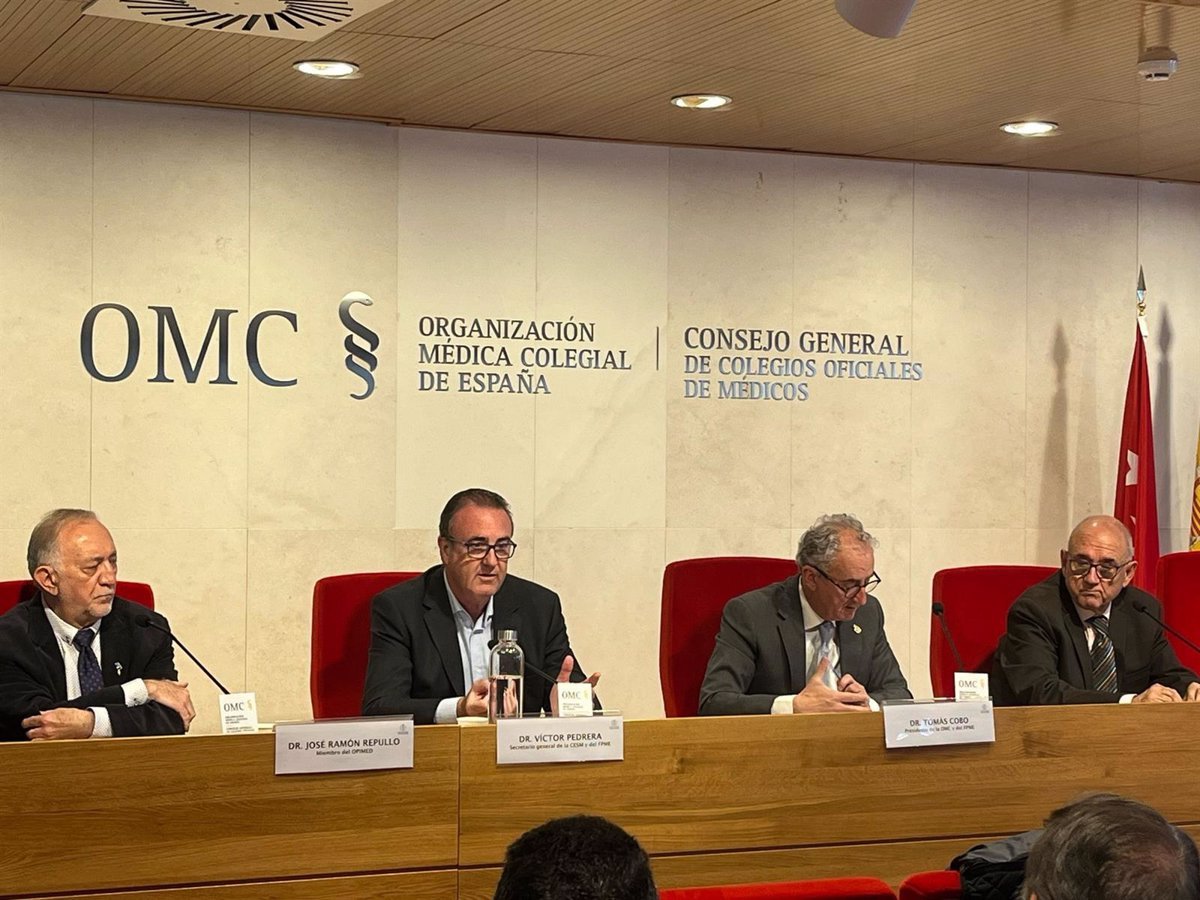
The Medical Profession Forum has called for the professionalization and depoliticization of the management of healthcare centers and services, where it has denounced a «situation of partisan politicization» in the appointments of directors. The goal is to ensure good governance and guarantee the quality and safety of clinical practice.
«The political influence has permeated to such an extent that a change in government means a change in the management of medical direction in each hospital, from the smallest to the largest,» said the president of the Medical Profession Forum and the General Council of Official Medical Colleges (CGCOM), Tomás Cobo, at the press conference presenting the document ‘Good Governance of Healthcare Centers from the perspective of the Medical Profession.’
According to his own experience, the changes in hospital management every time there is a political change lead to healthcare professionals having to repeat explanations about the situation of the center to the new manager to determine strategies. «The lack of professional continuity,» he pointed out about the issue.
«Professionalization means accrediting a series of conditions, requirements, and capabilities to hold the position. Just as one trains in a medical specialty, one should also train in a clinical management specialty, which is, in fact, what does not exist today, a regulated training,» explained the secretary of the Medical Profession Forum and general secretary of the Spanish Confederation of Medical Unions (CESM), Víctor Pedrera.
In this regard, he lamented that this lack causes in some cases «serious or important deficiencies» in governing healthcare centers. «I believe that professionalization, I insist, inevitably involves the need to plan a regulated training in clinical management, which is what our healthcare systems really need,» he asserted.
At this point, the document contemplates the «reconstruction» of the collegiate governing bodies, as added by the professor of Planning and Health Economics at the Carlos III Health Institute (ISCIII) José Ramón Repullo, who has acted as a representative of the working group that has prepared the text and pointed out that these would be an «adequate firewall» to mitigate political interference in the professional field.
In this line, the document establishes that collegiate governing bodies will have «a central role» in regulations and norms, annual budget preparation, investment plans, strategic and director plans, changes in service portfolio, program contracts, and annual reports.
EXCLUSIVITY OF SERVICE CHIEFS
On the other hand, Tomás Cobo highlighted another aspect reflected in the presented text, such as the importance of «management autonomy» in each of the services, an autonomy that depends on the service chief. «The role of the service chief is absolutely key to the sustainability of the National Health System (SNS),» he emphasized, pointing out that they are responsible for developing the best human resources chart based on care needs.
In connection, asked about the link of this idea with the proposal included in the draft of the Ministry of Health’s Framework Statute to require service chiefs to work exclusively in public health to mitigate conflicts of interest, Cobo stressed that «it is a first draft,» so negotiation room should be left.
Nevertheless, he indicated that this exclusivity can be naturally generated «if the right conditions are met for that service chief to stay and not need to go to other work environments.»
On their part, from CESM, Víctor Pedrera highlighted that they have opposed «clearly and forcefully» to the demand for exclusivity because it already exists and is regulated. Moreover, he criticized the proposal for the exclusivity of resident doctors (MIR), as it is only required for doctors and not for other graduates. With all this, he assured that this regulation can only lead to «loss of talent.»
LINES OF ACTION
The document ‘Good Governance of Healthcare Centers from the perspective of the Medical Profession,’ developed by the Observatory of the Medical Profession and Identity (OPIMED) of the Medical College Organization explains why it is essential for good governance to prevent conflicts of interest in both private (economic and commercial) and public (political and financial) healthcare centers, for which good governance tools must be used.
Thus, it contemplates seven requirements of good governance for all types of healthcare centers and care organizations, whether public or private. Specifically, it points to the need to develop and disseminate its Regulations; publish and update its medical chart and portfolio of services; establish and activate the Technical-Assistance or Faculty Board; and constitute and/or strengthen the Clinical and Patient Safety Committees.
To these are added, creating an anonymous reporting system for abuse and illegalities supervised by the health authority; establishing credential committees that support selection and serve as a support to document merits for promotion and career; and creating a body for inspection and evaluation of quality and safety of clinical practice in the regional health authority.
More specifically for public or affiliated healthcare centers, ten lines of action for good governance are formulated, one of them being the establishment of collegiate governing bodies. It also includes innovating in management models with greater autonomy and accountability in accountability; that the regulations and norms of healthcare centers actively promote a culture of best practices and professional ethics; and promote participation, transparency, and accountability.
Likewise, it proposes professional and social participation; strengthening management contracts between the health authority and its centers; resuming the care organization of hospitals and other healthcare centers based on clinical management, the creation of Institutes and Clinical Management Areas, and responsible decentralization through clinical management agreements; testing new models of territorial articulation of specialties through regional multi-hospital and multi-specialty hospital networks; and evaluating integrated management models Hospital + Primary Care, and if necessary establish specific governance and management bodies for the Primary Care level.
With all this, Tomás Cobo has recalled that many of these proposals are already included in other documents, but the Forum’s objective is to update them and transfer them to the Administration for implementation. «There is a crisis of implementation, not a crisis of ideas,» he emphasized.
FUENTE