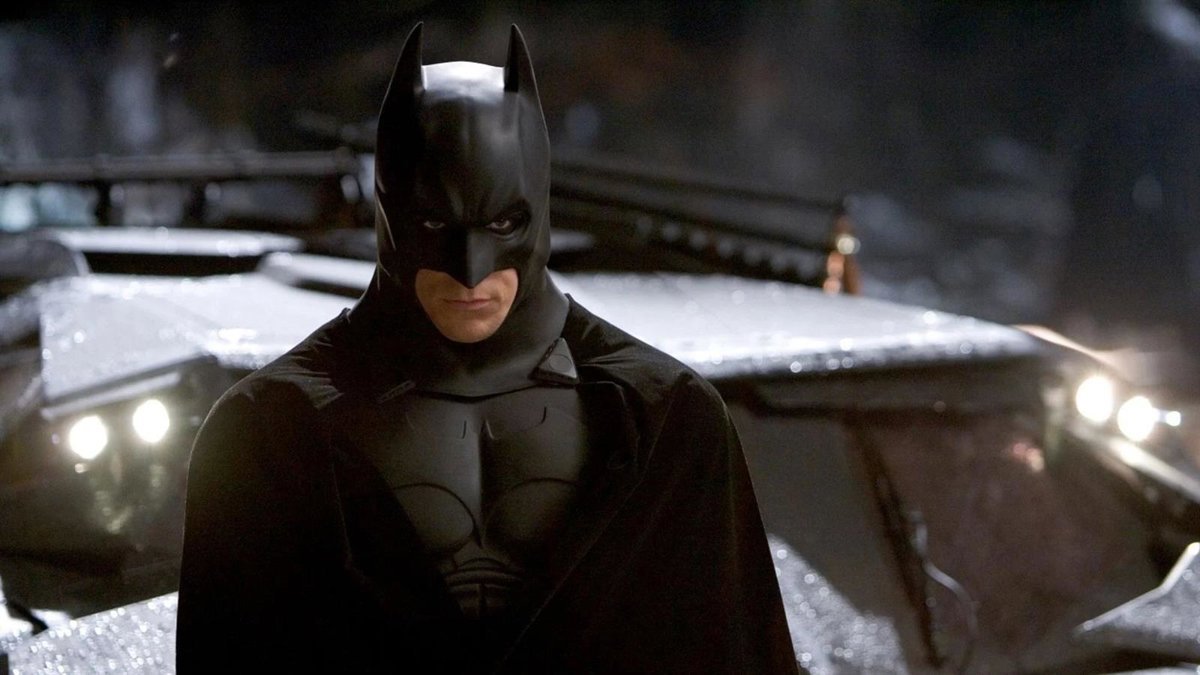
Twenty years ago, on June 17, 2005, Batman Begins premiered in Spanish cinemas. The first installment of the trilogy that Christopher Nolan would use to make a turning point in a not-so-common superhero film industry was initially met with reluctance and skepticism by fans who had already seen one of DC Comics icons mistreated to the point of ridicule. However, despite the initial skepticism, the resurgence of the Dark Knight was, in Nolan’s cinematic style, epic.
DC’s great detective was at his lowest point, at least on the big screen. A degradation that was epitomized by the ridiculous bat-nipples worn by the then superstar George Clooney, who disastrously portrayed Batman and Robin. The 1997 movie directed by Joel Schumacher, with a script by Akiva Goldsman, was heavily criticized by both audiences and critics. The failure was so resounding that, even though Schumacher had another DC movie in the works -an almost complete first draft of a script titled Batman Unchained-, it soon became evident that he would be leaving the franchise.
Before Nolan came to the rescue of the Dark Knight and Christian Bale donned the Batman suit, Warner Bros. had several projects on the table to revive Bruce Wayne on the big screen. Some came very close to becoming a reality.
From June 1997, when Schumacher’s film was released, to the release of Batman Begins in the same month of 2005, almost a decade passed during which many plots and many names of directors, screenwriters, and actors were considered by the studio holding the cinematic rights to DC characters. Frank Miller, Darren Aronofsky, or Wolfgang Petersen were some of the directors who were strongly considered to lead the new Batman reboot until in 2003, the studio finally decided on Nolan’s vision.
The young British director, who had already shown his great potential in the brilliant Memento and the thriller Insomnia, his first film with Warner, teamed up with David S. Goyer – screenwriter of the Blade trilogy and films like The Crow: City of Angels or Dark City- to bring back the character created by Bob Kane and Bill Finger to where he belonged.
BALE AND NOLAN’S CONSISTENCY
With a bulked-up Bale – who had previously literally starved himself for The Machinist and had to gain a lot of muscle to fill Batman’s suit – leading the cast, Nolan assembled a cast that included powerful names at that time such as Liam Neeson, who played the mentor and villain Henri Ducard/Ra’s Al Ghul, and the media sensation Katie Holmes as Rachel Dawes, the protagonist’s love interest.
To strengthen the main cast of the film, the filmmaker also surrounded himself with figures like Michael Caine (Alfred), Cillian Murphy (Scarecrow), Gary Oldman (Commissioner Jim Gordon), and Morgan Freeman (Lucius Fox). These names, like Penny to Desmond in Lost, would become constants in the British director’s films.
With a top-secret script (legend has it that he refused to photocopy it for Warner executives, who had to go read it in the garage where Nolan worked on the script with Goyer, and on the sketches and models of the film with production designer Nathan Crowley) and loosely inspired by several key works from DC hero’s vast comic book heritage like Batman: Year One, The Man Who Falls, or The Long Halloween, Batman Begins was a much more mature, dark, and emotionally believable origin story than what was the norm in transitioning from the comic pages to the screen.
That darker and grittier tone, enhanced by Hans Zimmer’s masterful composition, permeated the over two hours of film, a perfectly oiled artifact as functional as the hero’s new suit and, just like Lucius did with Bruce Wayne’s armor in The Dark Knight, would be improved in the sequel.
Among the many strengths of this first film were its few but powerful action sequences (the final ‘set-piece’ is simply monumental), Wally Pfister’s cinematography, which departed from the baroque and fantastical style of previous films and was able to turn Chicago skyscrapers into Gotham, and an elegant iconography that was meticulously crafted and, most importantly, explained.
Thus, Nolan’s trilogy is the only place in the multiverse where the fact that a billionaire dresses up as a flying rodent and goes out to kick butt when the sun goes down not only seems minimally reasonable… but it is even logical, just, and necessary. Realism, realism, and realism. That was the mantra repeated by the British director in each and every one of the many promotional interviews.
IT WASN’T A BOX OFFICE HIT
Although the box office performance of Batman Begins was modest, just over $370 million, placing it as the tenth film in a ranking led by the $900 million of Star Wars: Revenge of the Sith and Harry Potter and the Goblet of Fire, the critics responded very positively, as did the audience who saw Batman once again as a reference in the world of capes and tights (functional armor, in this case).
With the wind blowing in favor of the Dark Knight once again, The Dark Knight (2008) and The Dark Knight Rises (2012) followed. The second installment is, for many fans, the best superhero film of all time, and the third, a worthy conclusion to the acclaimed trilogy, although undoubtedly the most divisive of the three.
With such an epic and solid saga, a more definitive ending was expected… but Nolan chose not to, didn’t dare, or wasn’t allowed to, for fear of what might happen in the future, to kill off the Batman. He only feigned it, leaving the door open for a fourth installment that, 20 years after the trilogy began, seems more than improbable.
Together, the three films grossed nearly $2.5 billion, and with them, Nolan established himself as the great champion of the blockbuster auteur. A status that he would solidify in those years with The Prestige, Inception, or Interstellar, the titles that followed each of the films that make up the trilogy that redefined the way superhero films are conceived and executed.