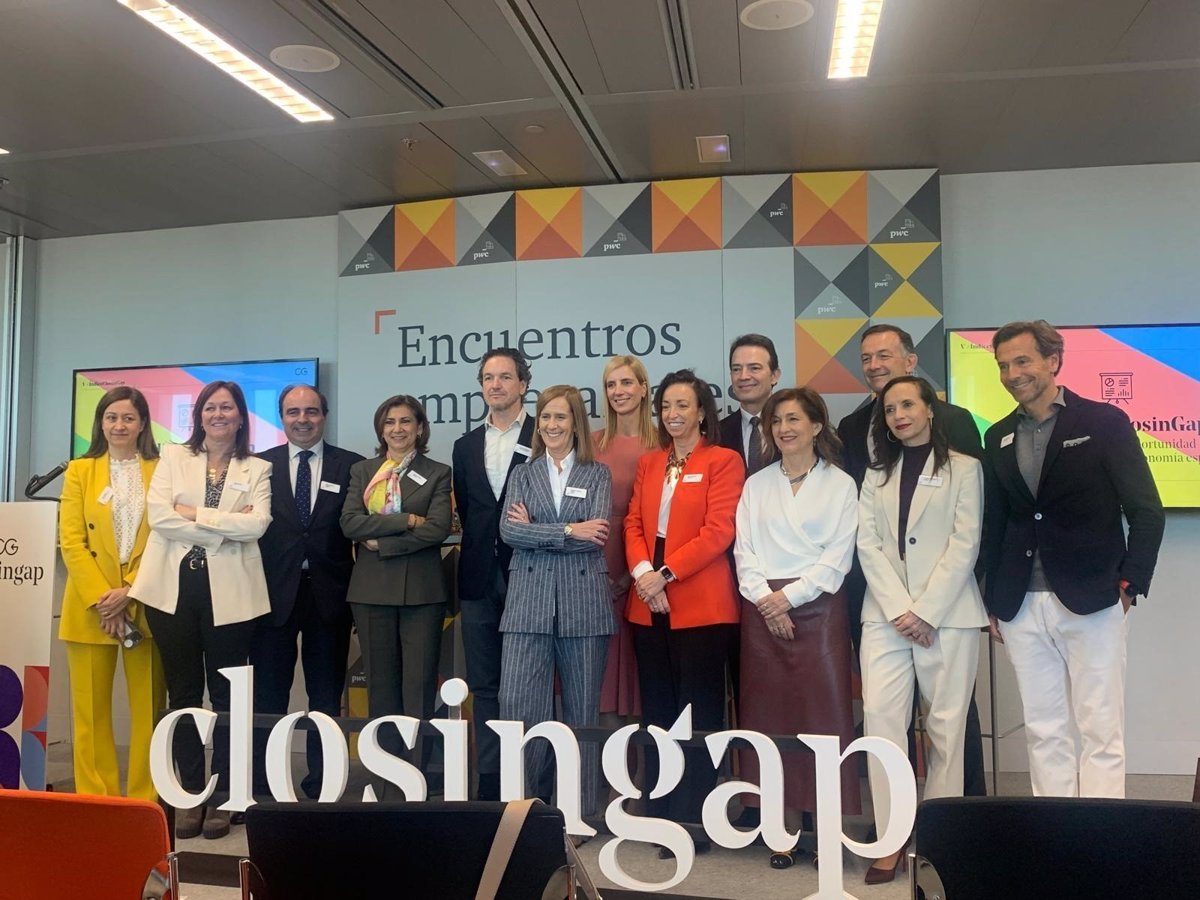
Spain will need 37 years, if the current pace continues, to «completely» close the gender gap between men and women, according to the V ClosingGap Index, presented this Wednesday in Madrid. It also reveals that the economic cost of gender inequality in Spain is 255,755 million euros, equivalent to 17.1% of the GDP in 2023.
The gender parity in Spain has improved for the third consecutive year and reached 65.7% in 2024, which is 0.8 points higher than the previous year. The year 2061 is projected as the year when the gender gap would be closed if the current trend is maintained.
The economic impact of inequality is attributed to three factors: lower labor force participation of women, as they still work fewer hours and in fewer numbers than men; higher presence in part-time jobs, reducing their contribution to the GDP; and lower representation in high productivity sectors such as STEM disciplines and the digital field.
The report analyzed five areas affecting gender parity, showing positive progress in Conciliation (+1.3%), Digitalization (+1.2%), and Employment (+0.7%). There was a maintenance in Education (69.9%) and a slight decrease of 0.2 points in Health and Wellbeing (83.7%).
During a press conference, Lucila García, the Director General of the ClosinGap Association, emphasized that despite advancements, «conciliation remains a pending issue.» She called for public policies and corporate strategies promoting real shared responsibility between men and women.
In terms of employment, there has been an increase in women in leadership roles in the private sector, while a decrease was noted in leadership positions within the public sector. The Employment gap stands at 68.1%, leaving a 31.9% gender gap to close, with progress in reducing the wage gap but less advancement in activity and employment rates, hours worked, and female representation in leadership roles in the public sector.
The Education gender gap remains stable compared to the previous year, with a slight increase in women in STEM careers. However, this increase is more due to a decrease in the number of men in these disciplines. The indicator stands at 69.9%, leaving a 30.1% gap to close.
Anna Merino, the Director of Strategic and Economic Consulting at PwC Spain, highlighted that the challenge of STEM education remains crucial. Despite some improvement, it is still insufficient. Breaking stereotypes that deter girls from these disciplines at a young age and encouraging their participation in technological and scientific fields, which are the engines of the future economy, is essential.
THE CONCILIATION APPROACHES PRE-PANDEMIC LEVELS
Conciliation saw the most significant growth in the last year, reaching 43.4%, approaching pre-pandemic levels when it was the most affected variable. The number of women inactive due to household chores decreased in 2024, showing a positive trend in recent years. Although the part-time rate for conciliation purposes is approaching parity, the report authors call for continued promotion of policies and practices supporting work-life balance for both men and women.
«Conciliation remains a significant challenge. Despite progress, women still bear a disproportionate burden in household chores and family care. This not only affects their professional development but also impacts the country’s economy,» García denounced.
In the field of Digitalization, there was a significant increase since 2018, with a growth driven by more women in ICT jobs. However, this sector still has the highest gender disparity within the digital segment, with an indicator of 75.1% and a 24.9% gender gap to close.
In Health and Wellbeing, the indicator reached 83.7%, with a 16.3% gender gap remaining in this area. Despite achieving greater parity in this category, the trend has not been favorable for women in recent years, with a 0.2% decrease in 2024 due to increased risk of poverty or social exclusion and a decline in healthy years compared to life expectancy.
According to the data, Anna Merino emphasized that gender equality is not just a matter of social justice but also competitiveness and economic growth. With the potential opportunity of over 255 billion euros for the Spanish economy, this potential cannot be ignored.
Marieta Jiménez, the President of ClosinGap, stressed the need for decisive action. «We have solid, irrefutable data showing that with political will and corporate commitment, progress is real,» she affirmed.
TELEWORK MAKES WOMEN LESS VISIBLE
Following the study results announcement, a roundtable discussion took place with Beatriz Corredor, President of Redeia; Arturo Gonzalo, CEO of Enagás; and Marta Machicot, Chief People Officer of Telefónica.
Corredor expressed concern about the lack of female talent in scientific and technological areas, emphasizing the need for diverse talent in digital transformation and energy transition. She also warned about the risks of teleworking for women.
«Be careful with teleworking, ladies. It’s a double-edged sword because it means being absent from decision-making centers and positions of power. Even today, professional interaction systems still favor a male model that rewards presence and extra hours. If women are not present, they risk being invisible and their talent going unnoticed,» she cautioned.
Gonzalo highlighted his company’s commitment to inclusion, referring to the ‘Ellas te lo cuentan’ program where STEM professionals share experiences to inspire new generations. He emphasized that if there are no competitive female candidates in a selection process, something went wrong.
Finally, Machicot emphasized the importance of ensuring transparency of opportunities and increasing awareness within companies so that women can advance without obstacles. She called for a collective mindset shift where work-life balance is seen not as a hindrance but as a shared right.
FUENTE