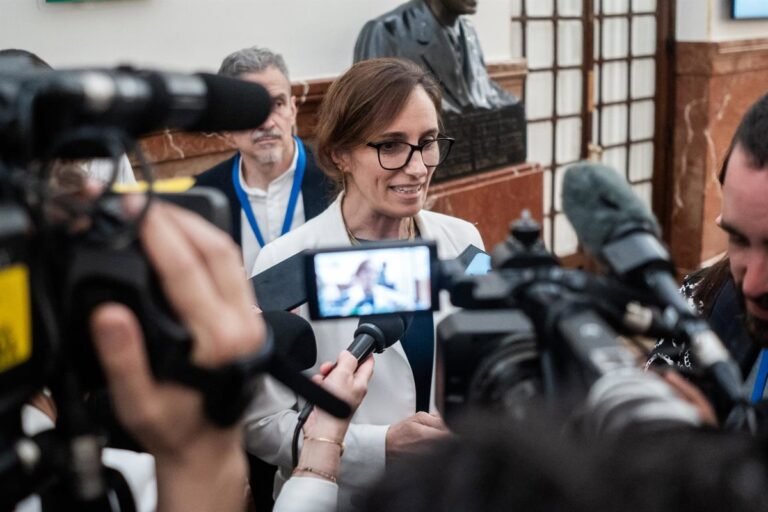

Journalist and writer Mara Torres has stated that «suicide can be prevented» and that «silence, stigma, and lack of information have not helped families or those who suffer,» in an interview with Europa Press on the occasion of the publication of her «real novel» ‘Recuérdame bailando’ (Editorial Planeta).
Torres reflects in her new book on suicide through her first-person account, which includes the moments after the suicide of her younger sister Aly, and through Aly’s personal diary.
With the intention of allowing the reader to enter the lives of the characters, their context, and circumstances and «then draw a conclusion,» Torres shares her personal story to also break the «silence, stigma, and taboo surrounding suicide, which hinders access to information.»
‘Recuérdame bailando’ combines a part linked to grief and the loss of a loved one, «in which everyone can identify with,» as noted by Torres, with the life of a thirty-something, that of Aly.
The book contains two very distinct parts. The first recounts how the family received the news of Aly’s death and the second shows excerpts from Aly’s personal diary, unknown to the family until her death and written during the last five years of her life.
«It is the unexpected and untimely death of a family member, in this case a sister. There is a part where the reader can identify with the pain, sadness, ritual, and comfort that those first days of mourning with all the people who care about you entail. And then there is a part that is the story of my sister where you are reading the life of a thirty-something. So it is also very easy to identify with things that happen,» Torres explained.
The author reflects nearly 12 years after the death of her sister Aly, her duality, characterized by a known, «luminous» side, and by another internal and hidden side, which she captured in her personal diary.
«My sister had a luminous life, on one hand, a vitalistic life, going in and out, friends, colleagues, family, music, movies. And then she had a part that is related to writing, which has to do with a deep sadness, a gradual sinking, with something that had been brewing within her for many years. That is what we discovered when we read the book,» Torres said.
«TOOLS AND INFORMATION ARE LACKING»
When she started writing this book, Torres was convinced that she would not sign it, a initial decision that gave her «a lot of freedom as an author» but that she eventually abandoned.
She decided to publish the book with her name because, as Torres emphasized, there are 4,000 suicides a year in Spain, surpassing the deaths from traffic accidents, which are around 600.
«It seemed to me that if I didn’t sign it, I was participating in the silence and taboo, that I was saying that it hadn’t worked out for us,» Torres said.
«Tools are lacking, information is lacking to address what is happening to them or where they can go, which is to the doctor where they should go,» the author reiterated, stating that she decided to sign it «after much deliberation» with her family.
«FINDING CLUES»
‘Recuérdame bailando’ recounts, among other events, the suicide attempt Aly had at 13, 30 years ago, when «there was no information about mental health and no one talked about mental health in everyday life or in the media.»
«We were told it was a cry for help, to be attentive, but not to give it too much importance. I think that marked our relationship with suicide,» Torres said, highlighting that today it is known that a first suicide attempt exponentially increases the chances of it happening again.
Torres noted that there is more information now than before, although «not much yet,» and «the importance» of ‘Recuérdame Bailando’ «is to find risk factors, find clues.»
«There are some linked to mental illness that we now know are clues linking her to some pathology she may have had, but since she didn’t tell us, we didn’t know how to address it. Certainly, the role of therapists, psychologists, and psychiatrists is crucial. They play a fundamental role, and the silence, stigma, and taboo surrounding suicide also prevent us from accessing that information,» the author considered.
Aly’s diary speaks of «a runaway neuron,» of «feeling undiagnosed,» or that her mind «makes her make decisions she doesn’t want to make,» thoughts that Mara Torres’ family was unaware of, as revealed by Torres.
«She didn’t understand herself. The thing is, she didn’t tell us because she didn’t want to worry us because she didn’t know what to tell us, I understand. There was a lack of information that I believe is important to highlight; we don’t have the tools to handle situations like this,» Torres concluded.