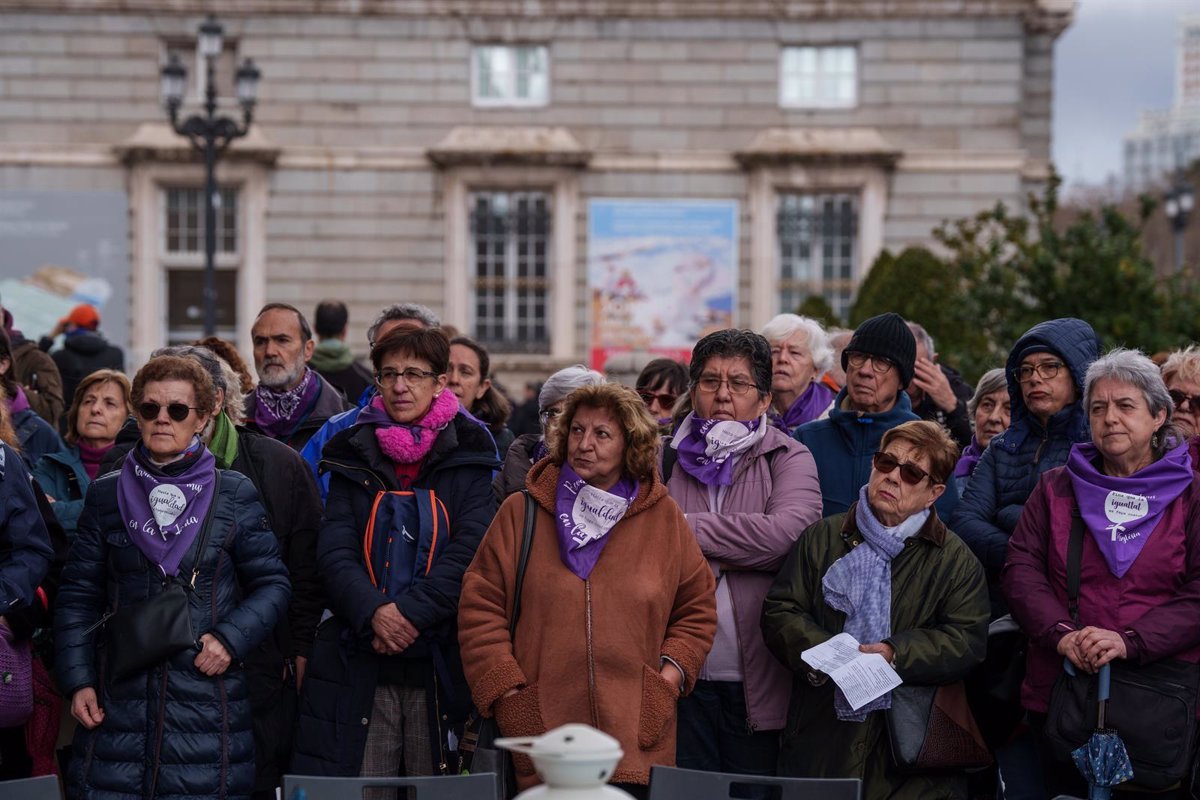
The Women’s Revolt of the Church in Madrid gathered this Sunday in front of the Cathedral of La Almudena to demand a "radical reform" of the Church in the face of the "deep discrimination" they receive for being women, on the occasion of International Women’s Day, celebrated on March 8.
"We demand equality in participation and decision-making spaces, which is still absolutely insignificant and very important. We ask for a profound renewal so that the dialogue between Christianity and feminism is recognized. We understand that it is impossible to be Christian and not be in favor of women’s liberation," said Pepa Torres, a member of the Women’s Revolt in the Church and the Commission for Justice and Reparation against Church Abuses against Women.
Torres pointed out that it is a "pity" that Christianity and especially the Church are identified as "a great bastion of patriarchy." "One of the characteristic signs of the Gospel was the discipleship of women and equality with men," she said.
For her part, Teresa Casillas, also a spokesperson for Women of the Church, lamented in statements to Europa Press that it is "really difficult" for women to see altars "full and overflowing" with men, although she acknowledges that thanks to Pope Francis, progress has been made "a little."
"We have seen women vote for the first time in a Synod, but there are still holes that continue to bleed. One of them is access to the sacraments and especially to the priesthood. The fact that in this century it is still believed that women cannot be a sign of God with their female bodies is something that is truly anachronistic," she criticized.
Under the motto ‘Believers and feminists for an equal Church,’ Women of the Church have demanded that the Church once again become a "community of equals" and have proclaimed the need for "equality to become a habit." Their demands have been made in the 30 territories where the various Revolts are already present: Alicante, Antequera, Badajoz, Barcelona, Bilbao, Burgos, Cabra, Ciutadella, Córdoba, Donostia-San Sebastián, Granada, Huesca, Huelva, Las Palmas de Gran Canaria, Logroño, Madrid, Málaga, Oviedo, Pamplona, Salamanca, Santander, Santiago de Compostela, Sevilla, Tenerife, Valencia, Valladolid, Vitoria-Gasteiz, Vigo, and Zaragoza.
EQUALITY, AN "ESSENTIAL" CHANGE
In Madrid, the group read a manifesto in which they called for renewal in the Church and social transformation regarding gender perspective. "We raise our voice and demonstrate because we experience deep discrimination in the Church and the time has come to say enough. We cannot and do not want to remain silent. We are tired of the inconsistencies and authoritarianism that we perceive daily, and therefore we can denounce the multiple forms of injustice and invisibility that we suffer in the church," read one of the spokespersons.
The Revolt believes that the Church is "falling behind in the social conquests of equality and responsibility," something they have called an "error" and for which they have demanded an "essential" change.
"The access to the diaconate and the female priesthood to serve the Christian communities. We denounce the disproportion between the number of prepared theologians and the positions they hold as teachers in theology faculties and other positions of responsibility. We want to make our tireless and free work visible," they exclaimed.
In this sense, they highlighted that women are an "overwhelming" majority in volunteering actions, religious celebrations, catechesis, pastoral care, as well as in social actions with the most vulnerable people, in ecclesial movements, in education, and in religious life. "We are the hands and heart of the Church, but we are denied the word. We are denied a voice and vote, decision-making, and leadership in the appropriate areas," they affirmed.
"What would happen to the Church and the Churches if we stopped doing all this? We are tired of invisibility and injustice. Years ago, we opened a gap in the wall that prevented us from accessing theology studies, and we will not stop until the wealth of feminist theology is recognized and valued as a catalyst for change. We will not stop until patriarchal and sexist language is eliminated in homilies, liturgical texts, and documents. And we will not stop until the Church’s sexual morality is filled with tenderness and mercy and stops blaming women," they concluded.
Likewise, they stated that they seek for the Church to denounce the neoliberal economic system that "prevents people from having living conditions in line with dignity." "This system exploits the earth, promotes the feminization of poverty, and encourages the labor and sexual exploitation of women," they concluded.
SHARED TABLE
In the spiritual performance event, an allegory was represented about the shared table to which Jesus of Nazareth invited to participate over 2,000 years ago. Several women attended representing the victims of Gaza, women with divergent loves, victims of trafficking, domestic workers, women with non-normative bodies, among others. "We are all welcome to this feast of the Kingdom Banquet," they proclaimed.
During the celebration, the clamor of other "cries" was added, such as those of women violated "because poverty has a woman’s name"; Women crossing borders because the global economic system impoverishes their countries; Women precariously paid because the disconnection from creation is leading many peoples and homes to famine, war, energy poverty, and despair. "Ecofeminism is no longer an option, it is a necessity," they reiterated.
They also remembered women who died and were abused by "those who should have been their partners, accomplices, and friends." "This is how God wants us, with a voice and vote. We are the change. Church wake up, Christian women in revolt," they shouted.
The rainy weather in Madrid did not stop this gathering, so they shouted, "Water, water, there is much to wash. Centuries of machismo and patriarchal violence." Among the chants, ‘Instead of cleaning, we want to preach’; ‘Church in equity, more votes and parity’; ‘A clerical church cannot be endured’; ‘Enough of abuse of power against women’; ‘We want more Marys in the vicars’, among many others. Additionally, they sang ‘Women forward, machismo backward,’ a chant repeated in feminist marches.
Finally, they carried banners with the image and name of the most important "matriarchs" of the Church and Catholicism, such as Mary of Nazareth, Mary Magdalene, Clara of Assisi, Edith Stein, or Dorothy Day.