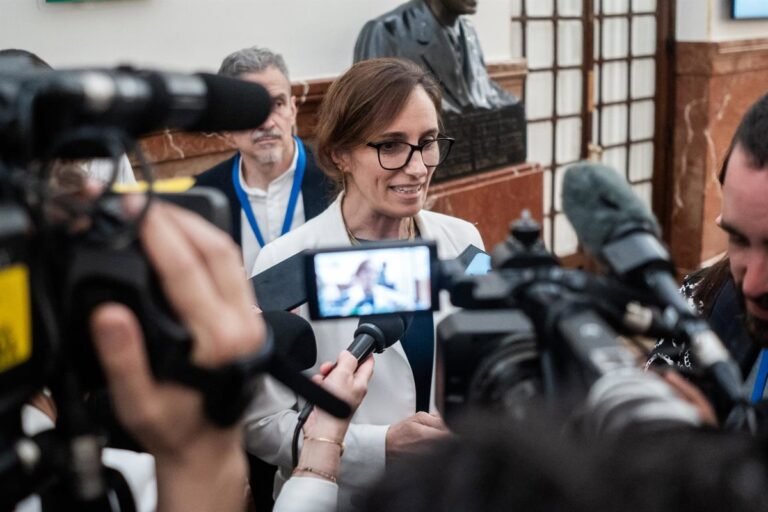

Miranda maintains that the law was «good» because it decentralized urban planning but acknowledges the «feeling» that changes need to be introduced.
The Government of Canarias has initiated the process of updating the Land Law – approved in 2017 – with the aim of simplifying and clarifying urban planning procedures and regulations while incorporating new indicators on urban agenda, ecological transition, and demographic challenges.
The details of this initiative, which has received contributions from about 800 people from public institutions and professional associations, were presented this Wednesday at a press conference by the Minister of Territorial Policy of the Government of Canarias, Manuel Miranda; the Vice Minister of Territorial Planning and Demographic Challenge, Elena Zárate, and the Director General of Territorial Planning, Onán Cruz.
The draft of the new law implies a commitment to structural urban planning over detailed planning, reducing the content of General Urban Plans (PGO) by up to 40%.
Additionally, public expropriation deadlines are reduced, a decision justified by the ease of access to information due to digitization, and greater protection of the territory is encouraged with increased penalties, ranging from 60 to 300 euros for minor offenses, and doubling to 600,000 euros for the most serious offenses.
In this regard, the Canarian Agency for the Protection of the Natural Environment (Apmun) will substantially extend the intervention times for infractions by doubling the prescription periods from four to eight years.
Miranda also emphasized that there will be «not one more meter of urbanizable land,» although the law does allow for changes in land use justified by municipalities to develop residential or tourist areas, for example.
Moreover, this legal reform aims to increase public housing construction by raising the percentage of public land use transfer from 10% to 15%.
Regarding industrial land, tools are also introduced to improve degraded areas, with over 60,000 hectares in Canarias, and there is also a differentiated approach for agricultural land and municipalities with fewer than 10,000 inhabitants.
The law also eliminates the distinction between partial and special plans, equates Programs for Urban Improvement and Action (PAMU) with ordinance processing, and maintains declarations of insular interest.
Miranda, who has made efforts to defend the 2017 law as «a good law» but in need of an «update,» stated that this process stems «from below» due to a shared sentiment among urban planning institutions and professionals, making it not a «government imposition.»
THE PARLIAMENTARY PROCESS WILL BEGIN IN SEPTEMBER
He indicated that the «basic principles» of the 2017 law are not being questioned nor is the need to «return to Cotmac» – «I do not enter into that debate» – and expressed support for the «decentralization» to be in the hands of island councils and municipalities, adapting urban planning «to the new times.»
«Let’s not be misled, the law is being changed to improve it, update it, and make it more understandable and a faster and easier tool for all those who use it daily and have had difficulties in its processing and development at some point,» he said.
The draft will be presented this afternoon to Fecam, on Thursday to Fecai, and on Friday to parliamentary groups with a voluntary appearance before the parliamentary committee on Territorial Policy.
The Government’s forecast is for the text to enter the regional Parliament from September, once the public exposure period is completed, the approval of the Consultative Council is obtained, and the draft law is approved by the Government Council.
FUENTE