It has managed to adapt to platforms and streaming and offers viewers proposals that cannot be seen from the sofa
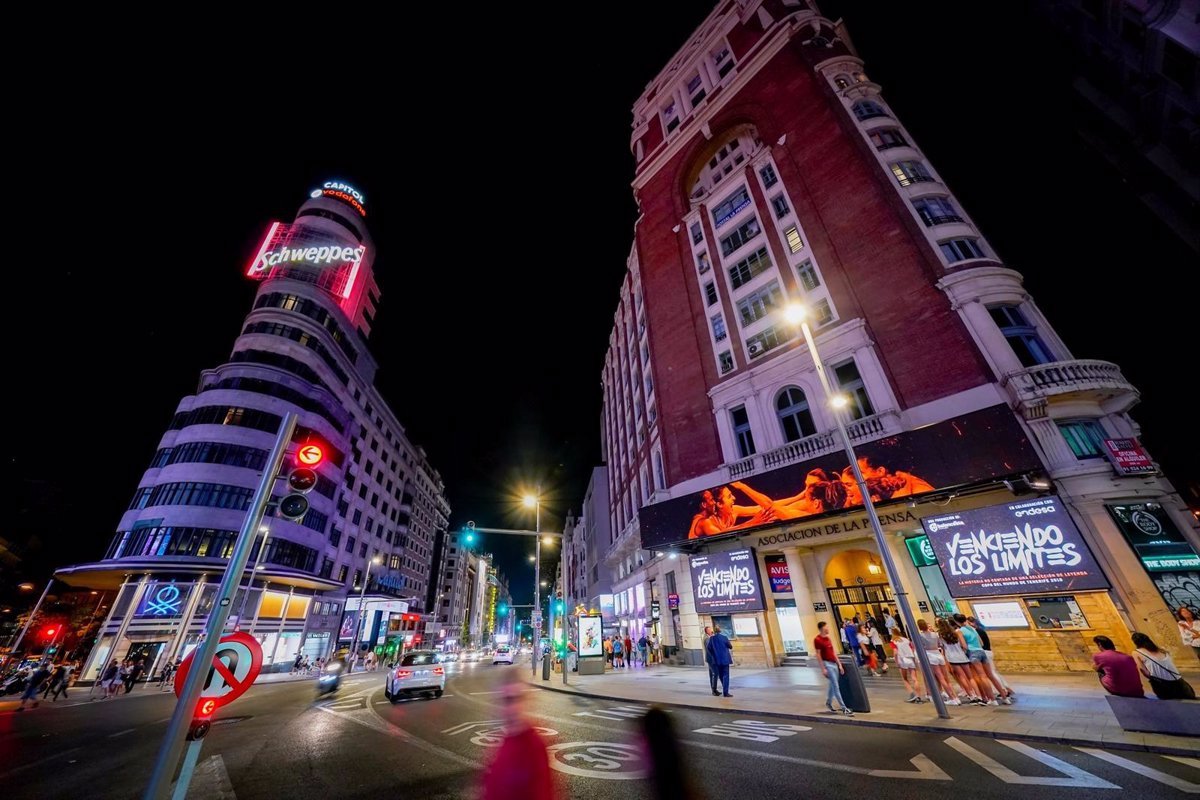
In the Madrid Gran Vía, where the lights, screens, and fast pace of the city never stop, a cultural refuge that has defied the passage of time survives: the Palacio de la Prensa. Inaugurated in 1929 by King Alfonso XIII, the first skyscraper in Madrid is now one of the last witnesses of a way of experiencing cinema that resists disappearing.
Designed by the young architect Pedro Muguruza with New York inspiration, the Palacio de la Prensa rose to 58 meters in height and 16 floors, becoming the tallest building in Madrid until the construction of the Edificio Telefónica just a year later. Its exposed brick facade set a trend, and its rooftop hosted personalities like Federico García Lorca, who promoted his theater company La Barraca from there.
The cinema hall was inaugurated on January 2, 1929, and to access it, one had to take the elevator. This detail, now anecdotal, generated long lines that led to a reform in 1941 to move the hall to street level. The next major transformation came in 1989 when it adapted to the trend of multiplex cinemas and was divided into three theaters: Sala 1, with 532 seats, and twin theaters 2 and 3, with about 200 seats each, in addition to Sala 0, which functions underground as a multifunctional space and a disco.
During the Civil War, the building received 72 projectile impacts, and in the 1940s, it was the headquarters of La Codorniz, the satirical magazine that slipped through the cracks of censorship. It has also been a meeting place for journalists and artists and a gathering spot for high society in the 1940s. In 2017, its uniqueness led the Community of Madrid to declare it a Property of Cultural Interest.
Over all this time, the film industry has changed rapidly. «When I started, a movie could be in theaters for a year and a half. Now, it disappears in two weeks,» says Juani Sánchez, one of the employees. «Before, there were scalpers, morning lines, premieres that were real parties. Today, almost everything is bought online, and the audience is more impatient,» she adds.
The workers at the Palacio de la Prensa not only attend to the public, but also safeguard its history. «Here, premieres have been screened, yes, but we have also done everything: marriage proposals, funeral tributes, book and record presentations, even Queen Letizia visited us at an event for Women for Africa,» proudly recounts Esther Nieto, a cinema ticket seller.
In her conversation with Europa Press, Nieto highlights one of the most surprising anecdotes she has experienced on the screen of this space. «A guy made a movie about his love story with his girlfriend. She had no idea. He brought her to the cinema, in the dark, and suddenly the room was filled with friends and family. At the end of the movie, he proposed to her. It was beautiful,» she recalls.
Both Juani and Esther, accompanied by María Salio from Super8, also recall the fan phenomenon that erupted on Gran Vía for the premiere of the final episode of Game of Thrones at this cinema. «It was at three in the morning, and since ten the day before, there were people queuing dressed up with wigs and dragons. Three full theaters. Every time something happened on screen, people shouted, applauded. It was a lot of fun,» they recount.
It wasn’t the only time Gran Vía came to a standstill. It has also happened with Wismichu, with El Rubius, with concerts and presentations by well-known artists. Sometimes, they point out, «the street has to be closed because the cinema is full outside before opening inside.»
And here, there was a time when for a major premiere, people even came with night vision goggles to prevent leaks and recordings inside the theaters. «That’s not seen as much now; a few years ago, piracy was more prevalent, and if video cameras were seen in the theater,» explains Juani. Another major change has also been experienced in the projection room, from large projections and film reels to being able to control the session from a computer with a single button.
REINVENT OR DIE
For almost a century, the Palacio de la Prensa has witnessed the changes that Madrid society has experienced from its privileged corner on Gran Vía. Also those of the industry, increasingly dominated by digital platforms.
Long before, there was a time when tickets were sold with Ministry bills, and you had to memorize the theater layout to avoid placing two viewers in different aisles. The ticket sellers remember it well. Just as they remember the time when everything was sold in the morning, and premieres were a real celebration. «Once we sold 60 kilos of popcorn in a single day,» they say.
The Palacio de la Prensa has managed to adapt to everything that came after. To platforms, streaming, the pandemic, changing habits. It has understood that today, to get the audience out of the house, something that cannot be seen from the sofa must be offered.
That’s why now there are screenings with live musicians, movie screenings accompanied by mentalism shows, concerts, podcasts, monologues, special sessions, and even conferences. Because it’s not just about watching movies, but living them. «We have even projected live opera and the Oscars gala, with people staying all night here,» Sánchez and Nieto highlight to Europa Press.
«We have reinvented ourselves because if not, people won’t leave their homes. But we do it without losing the essence. Because this is not just a cinema. It’s a place where things happen. Where life is lived,» explains Juani Sánchez.
WITH AN EYE ON THE FUTURE
Because far from appearing as a temple for mass events, the Palacio also has an intimate refuge. «Santiago Segura, Alaska, or Masiel have come a lot,» they remember, as for some, it’s «like their neighborhood cinema.»
And yes, many things have changed. Before, tickets were cut with Ministry vouchers. Now, they sell out in minutes with a click. Before, movies lasted months in theaters. Now, if you blink, you see them on Netflix. But there are still those who come, sit in the seat, and shut out the world for an hour and a half.
Now, the Palacio is preparing for a new renovation. Not to stop being what it is, but to return to what it dreamed of being. A place to watch a movie, listen to a concert, record a podcast, or cry over a good story.
And perhaps that’s what keeps it alive after nearly a century since Madrid looked to the sky. Its ability to be giant and close at the same time. To have history without seeming old. To project the future without losing the voice of the past.